 The History of Gear Project Presents:
 The History of Gear Project Presents:
This presentation by The History of Gear Project is under continuous development since 1997. Well over 45 of the classic American outdoor gear pioneers and their innovations are discussed and illustrated. Link to my Biography... Listed on this first page are many Works in Progress. In addition to this website, I offer professional consultation about the history, values and current status of the great classic gear companies and their brands. Also to note: I've published several books in this topic area, offered in traditional book, eBook, or inexpensive PDF formats (my ten books and links to order them, click here). Most recently, I have created a short and very modern site that focuses on my books; it's a short alternative to the vast detail in my main pages, see: www.historyofgear.weebly.com
THE FIVE HISTORY OF GEAR BOOKS AND MY BOOKS OF SHORT STORIES: The five history of gear books are presented in 8x10 format with choice of hardbound or softbound and all lavishly illustrated with high-quality color images. They can also be ordered directly from me as $15 PDF downloads (oldgear@oregonphotos.com).... The 6x9 b&w Warmlite book is our bargain book.... Book 1: "Frostline of Colorado," updated in 2012 after Dale Johnson, its founder, passed away (Frostline)..... Book 2: "GERRY, To Live in the Mountains," updated in late 2010 after Mr. Cunningham passed away, and enlarged in 2019 (GERRY)..... Book 3: "Holubar Mountaineering, Ltd.," rightly regarded as the inventor of the modern lightweight down sleeping bag, among other honors (Holubar). The Holubar book was lauded in 2012 as one of the year's best "Local History" books at Chautauqua in Boulder, Colorado...... Book 4: "MSR: Defying Tradition, describes Larry Penberthy's often controversial rhetoric as he took on the Climbing Establishment through his Seattle-based Mountain Safety Research company (MSR) (MSR)..... Book 5: "Warmlite: Still Controversial After All These Years" tells the tale of Stephenson's Warmlite Equipment, with its radically innovative products and boldly notorious nudist founder (Warmlite). All five books feature major contributions from their founders/Presidents or chief personnel. You may order the books directly from my Publisher, and the PDF versions directly from me (brucej@oregonphotos.com).... My books of mountain stories are short and very personal books; eg. "Dawning," which is about spiritual awakenings in the mountains, is set up as a Kindle book through Amazon. I am a verified PayPal seller.

Please Note: All Material below, and in all my "History of Gear" webpages, is copyrighted, and no usage of my material is permitted unless explicit permission is granted by me, Bruce B. Johnson, owner of OregonPhotos.com. Much of my material has been derived from interviews and correspondence with various company founders and management, as well as "common" folk who have owned, used and cherished the gear..Gear Lovers: if you were involved with one of the old-line, vintage gear companies and have a story to tell in these pages, pleasecontact me soon at jupiterman47@gmail.com -- Sponsors: if your outdoor company is interested in sponsoring this site, please contact me for details.. Publishers: currently I publish via "POD" technology, which has freedoms but leads to books that are relatively expensive; thus, I seek a traditional publisher. Finally, please see below for Disclaimer (click here).


Disclaimer: This Disclaimer applies to all the contents of my "History of Gear" site. The material on these pages represent only the reports of the correspondents and my own interpretation of those reports. In many cases "History of Gear" material is difficult to independently verify and that is a "given" in this type of research. It is important to keep in mind that the events, gear, and personages reported in the "History of Gear" lie far in the past, in some cases as much as 65 years in the past. It is common that even people who were within the same company so many years ago will remember/interpret happenings in quite different ways. Contact me: jupiterman47@gmail.com
I believe that many of the classic companies and their products represent a Better Way than the curses of modern consumerism that are presently ravaging our environment, and peoples worldwide, whether they be rich or poor. The best of the classic companies built products that were meant to last a lifetime, and often did. They used no overseas "off-shoring" that hurt their country's manufacturing base. They treated their employees like family in the truest sense of the word. They treated their customers personally and with great friendship and respect. The modern emphasis on Planned Obsolescence and Perceived Obsolescence* were unknown to them. Their adherence to keeping up with ever-changing "fashion" trends was minimal. They were not part of the "Fashion Industry." In a way, they represented a form of anti-consumerism, anti-consumption, and anti-capitalism.... I hope that my readers will come to appreciate and act on these kind of old-fashioned values through learning about these old classic gear companies. * these terms from Annie Leonard, "The Story of Stuff."-- A Swedish company with a US presence has a very strong dedication to these values, and states these very cogently on their page about their philosophy. And then there is an outdoor store in Portland, Oregon which has a large commitment to such values--- Click here for a link about "Next Adventure," which has an entire floor dedicated to the buying/selling/trading of used outdoor gear... Thank you.- Bruce Johnson, author of History of Gear website.
Steve contrasts the material goods of his childhood with what we have now in the 21st. Century --- "[in the1960s] all the material goods that filled our summer houses or basements--old fishing poles, reels, leader boxes, wooden hand painted lures, lawn furniture, tools, lamps, etc. [items made}. from the 20's to the 60's, all had weight, substance, and a richness in their materials; Mostly wood and metal. Today, a child looking back on their lakeside summers ... will remember a partially deflated high color vinyl air mattress that probably provided service for less than a week, and a range of other plastic toys. Nothing worth saving. There are luxury brands that continue to produce beautifully made products today, but the products from the past that were affordable to the middle class or upper middle class were made with the kind of care and materials that only the luxury brands are imparting today. It seems that many of the consumables today have next to no residual value once purchased. I am resigned to hoping that at the very least our recycling programs can deal with all the junk."
Steve W's words are sobering. The only answer I have is to try to live by what I call THE FIVE Rs as often as one can: 1. Reuse. 2. Recycle. 3. Repair. 4. Rejuvenate. 5. Rethink.... this last one, "rethink," requires a bit of explaining-- rethink "why" do you need to buy a new one? Perhaps more thinking will reveal more ways that you can use what you already have, perhaps a small modification or upgrade is all that is really needed.... In terms of THE HISTORY OF GEAR, we support buying used gear, fixing up what you have, cleaning, repairing, and modifying that durable classic gear. You will find the efforts deeply satisfying. My page about Frostline Kits has links to many vendors who will help you with this. And please visit Patagonia's site and join up to their very similar vision, which they call "Common Threads," http://www.patagonia.com/us/common-threads/
Last year I had the misbegotten idea to sell my Sierra Designs geodesic assault tent, the Tiros, original price $300. I posted it on a number of sites and had quite a few hits and inquiries. I asked only $95 for a tent in rather good condition and totally serviceable. Nearly all the interested parties did not even come to look at the tent when they discovered that the tent is approaching 30 years old. Two people finally did come and look at it on two separate occasions. One of them took one look at the light color of the canopy and accused me of trying to foist a tent on them that was extremely sun faded. This was totally incorrect since the canopy's original color was a very light color in the first place! And in a discussion with another potential buyer about proper care and maintenance of a tent, he admitted that he had bought only cheap tents, which had come apart within a year or two— zippers, fabric, stitching, etc. and then also admitted that he had ruined his last tent by putting it away damp. It seems that building products for obsolescence and the mentality behind that has reached into even our treasured outdoor gear. Now even the prestigious manufacturers crank out “new models” designed in Asia every year. The mentality appears to be that if you have a tent that’s more than five or 10 years old it’s become a piece of shit and needs to be replaced regardless of how much use it’s had, it’s original quality, or the conditions under which it's been stored. Take a look at the beautiful 4-season Tiros.
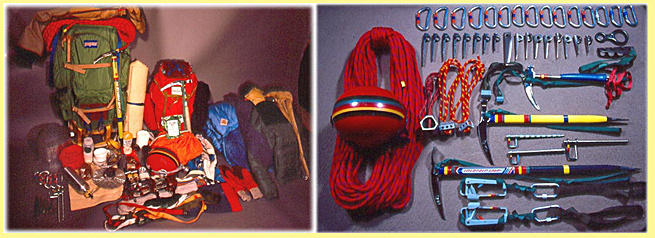
".... Why does anyone care about the old gear? I'll put in my two bits worth--the old backpacking gear from the 50s, 60s & 70s represented an era of freedom for a lot of people--a freedom to get out and explore anywhere from the woods behind your house and to the highest mountain ranges, a freedom to expand one's inner mind to unlimited boundaries and a chance to get back to the beauty this world has to offer. The old gear also represents an era of innovation, a willingness of companies to strike out and try different designs and materials in pursuit of the perfect product--be it a backpack, sleeping bag, tent or clothing. These companies each had an ethic that is hard to find in gear today--to make the highest quality backpacking gear of that era and for all time. Who can not love the loft one found in a Trailwise Slimline chevron-baffled down sleeping bag, the quality and durability of a Kelty Tioga external framepack, the versatility of a Sierra Designs 60/40 Parka and the sweeping lines of a North Face Oval InTention tent? Holubar, Gerry, Ski Hut, Rivendell, Class 5, Camp 7, Alpenlite, Hine/Snowbridge, Schonhofen, Maran, Snow Lion, Caribou, Adventure 16, Warmlite, Early Winters, Alpine Designs, Bishop, Petzoldt, Sunbird, Universal, Great Pacific Iron Works, Bugaboo Mountaineering, Forrest, MEI, Synergy, Alpine Style, Wilderness Experience, early Lowe, JanSport, Gregory, Cannondale, Camp Trails, EMS (Eastern Mountain Sports), REI, Eureka, the early MountainSmith, Bristlecone Mountaineering, and others I've forgotten--all these companies turned out gear that truly has been unsurpassed in its functionality, its appeal, its originality and its excellence. Sure, nostalgia is part of this vintage gear appreciation--the memories of trips past--but one needs a historical record of a time when quality was truly quality, and of those pioneers who sewed up the gear that started a revolution in backpacking, mountaineering and spinoff pursuits that continue to this day. We owe the 'gear pioneers' the recognition and apprecation they deserve by preserving and restoring the equipment they created for our enjoyment! " (image of old climbing and backpacking gear collection compliments of contributor Dan D.)
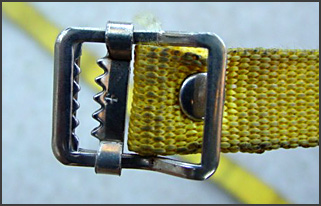
Above is an old-fashioned strap, the type popular during the 60's, 70's, and 80's. This one, I've had in my strap collection since about 1972. It still functions perfectly. As "J.K." asserts in his essay, it's truly a piece of "old gear" that was a near-perfect marriage of form and function, done in the new materials that had become available to backpackers during the Post- WW II period. Unfortunately, as the 1990s progressed, this elegant and perfect design was scrapped, replaced with plastic buckles of various designs. I tried them all; none worked nearly as well as my old trusty toothed buckles; a major flaw is how difficult it is with most of the plastic buckles to easily clamp down tight and be sure the buckle will hold, come thick or thin, as you crash through the brush. So my vote goes to this great classic strap design-- a hard nylon webbing of the proper width and thickness combined with a strong metal (not plastic) rivet, topped off with a simple, easily-operated, corrosion-resistant METAL buckle with teeth, and all nickel-plated! Long live Classic Gear!
I had heard repeatedly of the existence of a book
about the History of Gear that was written by British (English)
writers. 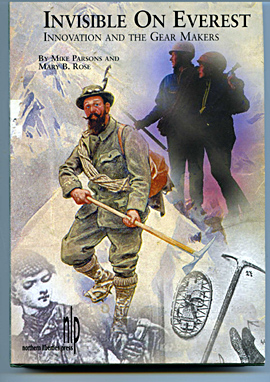 I finally
obtained a copy, actually the personal copy of Gerry Cunningham,
and inscribed to me! I've been finding it to be refreshing-- quite
a different look at the subject compared to what I've done in
my own History of Gear Project.
I finally
obtained a copy, actually the personal copy of Gerry Cunningham,
and inscribed to me! I've been finding it to be refreshing-- quite
a different look at the subject compared to what I've done in
my own History of Gear Project.
The book is named "Invisible on Everest- Innovation and the Gear Makers."
It bills itself as covering a time period from 1850 to 1995. It had four corporate sponsors: Grivel, Karrimore, The North Face, and Trangia AB.
As I read it, I was struck by the total absence of any interview material from the great American pioneers like Gerry Cunningham, the Lowe brothers, or George Marks and Bob Swanson. However, on pages 212-213 considerable credit is given to GERRY Mountain Sports and Eddie Bauer for their advanced gear used in the first climb of Everest in 1953, and in subsequent expeditions.... But other than that, the book's perspective is very European, with a real focus on British history of gear and climbers. Don't buy it to find out more about American pioneers and companies, but do buy it to broaden your horizons considerably!
The authors are Mike Parsons (past owner of Karrimor) and Mary B. Rose. It was published in 2003 by Northern Liberties Press, which lists offices in London, Paris, Philadelphia and Kuala Lumpur... . The price on the dust cover of my hardback is marked at $36.00. It is a 292 page book, with limited illustrations and scattered black and white pictures. The size is 9 1/4 inches x 6 1/2 inches. You may be able to order the book from OldCityPublishing.com