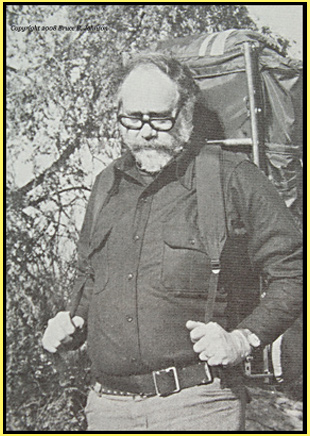
 circa 1970
circa 1970
circa 1970Ralph "Andy" Drollinger founded
A16 in 1957. He says, "..." It was a film company (imagine
that in Southern California!). They specialized in adventure
films. According to Stan Sieler, a co-worker with Drollinger at
Convair/General Dynamics, Andy himself said the name was because
A16 was his sixteenth business venture! Anyway, as the years passed,
Andy, a "Mechanical Design Engineer" by profession and
heavily involved in San Diego area Boy Scouts, began to turn his
talents toward
designing better camping gear for scouts, who included future
prominent pack maker Wayne Gregory...Wayne became A16's second
employee in about 1965, when Drollinger was still operating out
of his garage on Primrose Lane... Drollinger focused his vast
energies on thinking up new designs and materials for Tents, packs,
water bags, and other gear items. In this effort, Andy had ample
prodding and assistance from some similar-minded friends.
toward
designing better camping gear for scouts, who included future
prominent pack maker Wayne Gregory...Wayne became A16's second
employee in about 1965, when Drollinger was still operating out
of his garage on Primrose Lane... Drollinger focused his vast
energies on thinking up new designs and materials for Tents, packs,
water bags, and other gear items. In this effort, Andy had ample
prodding and assistance from some similar-minded friends.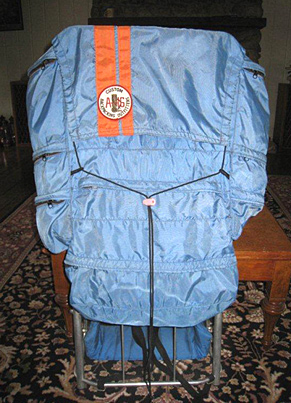 (image credit, blue
pack: Peter Ireland). Correct full name and spelling: "Ralph
A. Drollinger" (per Mr. Drollinger)
(image credit, blue
pack: Peter Ireland). Correct full name and spelling: "Ralph
A. Drollinger" (per Mr. Drollinger)
As early as 1962, the 6' 6" engineer had been hard at work turning A16 pack innovations into reality. This was at about the same time as Jack Stephenson, Warmlite's founder, and also an engineer in the aerospace industry, was doing the same kind of thing. Both in a way were turning their engineering expertise toward refining the frame pack design made popular by Dick Kelty during the mid and late 1950s... Drollinger says about Kelty, "My viewpoint of early backpacking is that Kelty [the man] nearly got it right the first time. His original packs [circa 1952-53] were and still are ergonomically unsurpassed when it comes to loads over forty-five pounds." He also adds this positive comment about the "Jack Pack" created by Stephenson in the early 1960s-- "Jack was close." ..... Bruce Wagner, who was the National Sales Manager for Kelty from 1968 to 1978, said this of Andy, "Andy Drollinger was a great big bear of a man, very friendly and always happy to talk about backpacking adventures. He was an aeronautical engineer and inventor ... not really a businessman ... and in the [early] '70s he sold the company to Mic Mead, who proceeded to build it into a large, successful chain of outdoor equipment stores.."
(Skip to page bottom for Andy's praises of Ann Benedict, the founder of Dri-lite Foods)
WHO GETS CREDIT FOR THE
FIRST "DOME TENT" ???
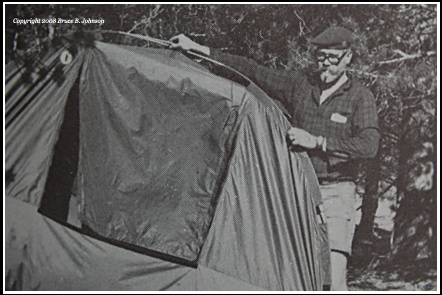 History
of Gear Credit #1 --First modern "Dome Tent" with modern
nylons and bent poles. This was well before the famous Jansport
dome tents came on the market in 1972, according to Murray McCory,
JanSport's founder.
History
of Gear Credit #1 --First modern "Dome Tent" with modern
nylons and bent poles. This was well before the famous Jansport
dome tents came on the market in 1972, according to Murray McCory,
JanSport's founder.
"The Dome Tent. We, at A16, called it the "A16 Dome Tent." Real original name! (when you are first, you can call it anything you want!)... It was made in a two and four man version. ..Did I invent it? I prefer to describe it as "innovation." Every thing had been around in one form or another. I just reassembled them in a new concept.
In fact, ever since the mid-60s, Andy had been working with a San Diego-area Scout leader named May "Bandy" Atherton. Bandy had a two-pole dome tent design which was quite trail-worthy. It was being sewn-up and used by Girl Scouts all over the area. According to Wayne Gregory, "Andy was helping her out cutting up the aluminum ferrels for her fiberglass tent poles and other material sourcing."
May's tents were colloquially known as "Bandy tents." If anyone gets the title of inventor of the backpackable dome tent, it should be her. (add picture of May). Bandy passed away in 2004, a legend of sorts among the Girl Scouts.
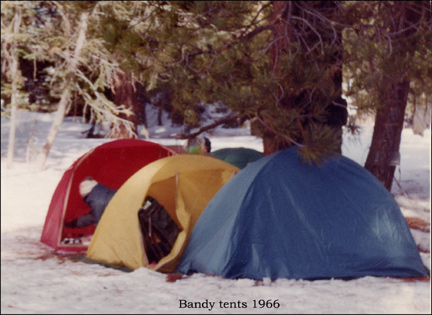
Andy told me, "the concept of bent poles was first produced by "Thermos." Yes, the "Thermos Bottle" people. Their version was made of cotton. The poles were solid fiberglass rods with aluminum tube sleeves as joints. A two man version weighed over 11 pounds. The poles were sprung up inside the tent canopy, on diagonal corners. The side door was zippered over the full curve of the tent. Thermos promoted it as a backpacking tent, but it was a small tent, and too much weight."..... EDITOR: the famed tent designer/guru Bill Moss is credited on the Bill Moss website with designing the Pop Tent in 1955, and licensing it to King Seeley/Thermos by 1959-60. The Pop Tent was certainly a "dome tent," but acros the Pacific, a company named Croster in Japan claims that they invented the "World's First" dome tent in 1959. My vote probably goes to Bill Moss, based on the information I've been able to amass.
Back to Andy Drollinger-- "In the early 1950s, the old timers such as Thermos and Coleman had to be dragged scratching and fighting away from cotton and into synthetics [eg. [nylon fabrics]. After all, they were the Kings. No new innovations in their empires."
"The Birth of the A16 Dome Tent: Somehow or other, I crossed paths with Jack Stephenson of Warmlite, another early lightweight tent maker. He lived in Northridge, CA [fairly near Mr. Drollinger]....He used waterproof coated two ounce [nylon] fabric with his poles on the inside. Easton Aluminum made his poles by draw-forming. No rain fly, so he provided a mickey mouse vent hole in the top to get rid of body accumulated moisture..." (Note 1: Easton Aluminum Company is better-known for producing the first aluminum baseball bats! It's owner Jim Eastman was a friend of Drolinger. Note #2: Wayne Gregory remembers both Drolinger and Stephenson attending a Sierra Club function in Balboa Park in 1965, as fellow vendors. Note: if you need a tent pole repair, one of Easton's original employees runs a pole company in Vancouver, WA, "Tent Pole Technologies." It's owner has done several great repairs for me.Easton tent poles
"I took a step back to the old cotton tents with an external covering rain fly. I made the tent from breatheable nylon... the poles were on the outside of the tent, held up the tent, and were covered with the rainfly...the original poles were hollow arrow shafts...This was the original use of bent poles to hold up the tent form and make a breathing space clearance between the tent canopy and the fly."
An interesting sidelight into the world of Patenting is recalled, "At A16 I received a letter from a lawyer telling me to cease and desist in using the segmented tent poles in the dome tents. His client had filed a patent for a portable radar reflector using similar poles...I chose to ignore him and I didn't hear from him again."
Regarding a special version of the A16 Dome made with all-mosquito netting canopy under the waterproof fly: "[We sold the tent] to game rangers in the elephant areas of Africa. They loved it! The elephants thought they were big rocks and wouldn't step on them. Inside the bug-proof tent it was like sleeping on a screen porch!"
Note: by the time of the 1975 A16 catalog, this original dome was being called the "Half-Dome," and came in 2 1/2 or 4 person versions. A key design feature was the "spring alloy aluminum poles." Weight was 5 1/2 pounds for the "2 1/2" person version. Prices were $179 and $199... The A16 company had grown to a staff of 24 people, headed by Mic Mead. (added note: Mr. Drollinger left A16 during the early 1970s).
History of Gear Credit #2--- The A16
Pack Line. The prize and joy of Drollinger was his perfected "Hiphugger"
suspension system, circa 1965. "The shoulder straps are padded,
so why not pad the backband?" This was some eight years before
Kelty even put a padded hipbelt of any type on their frame packs!
Drollinger recalls, "The problem with [the Kelty pack was]
interfacing the load at the hips. 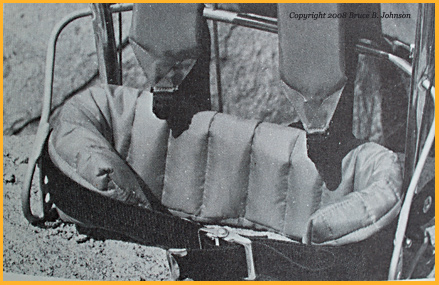 This
is the reason I started making packs. I recognized the marginal
comfort of the Kelty hip interface. The bottom backband was effective
only over a few square inches along the bottom edge. It showed
in dirty wrinkles along the bottom edge after it was used a few
times...In my final application the backband was mounted at two
points at the sides. It could swivel to match the lower back.
Complementary to this, the back band had a frustum shape (a shape
cut from a cone). The top edge being shorter than the bottom edge.
All this adds up to an optimum contact area between the backband
and the hips, for lower per square inch load interface."
Despite all of this, Drollinger retains high praise for the original
Kelty,"The best pack to meet optimum ergonomics is the original
Kelty frame with a padded hip belt system." He adds, "Early
on, I also made a padded backband for replacement on the Kelty."
This
is the reason I started making packs. I recognized the marginal
comfort of the Kelty hip interface. The bottom backband was effective
only over a few square inches along the bottom edge. It showed
in dirty wrinkles along the bottom edge after it was used a few
times...In my final application the backband was mounted at two
points at the sides. It could swivel to match the lower back.
Complementary to this, the back band had a frustum shape (a shape
cut from a cone). The top edge being shorter than the bottom edge.
All this adds up to an optimum contact area between the backband
and the hips, for lower per square inch load interface."
Despite all of this, Drollinger retains high praise for the original
Kelty,"The best pack to meet optimum ergonomics is the original
Kelty frame with a padded hip belt system." He adds, "Early
on, I also made a padded backband for replacement on the Kelty."
For a short time A16 entered into an agreement with Don Douglass, a 1970 college grad with an MBA: "He wanted to join forces with A16 and we formed a loose association. He sold A16 packs. When I got out of A16 [early 1970s], Mic Mead broke off the association. He [Douglas] started manufacturing a pack." Douglass' original outdoor stores like the Backpacker's Shop in Claremont had sold A16 packs, but now Douglass' chain sold his Alpenlite brand packs. Douglass' company became the well-known "Alpenlite" brand, which was sold by the thousands by Frostline Kits with their Frostline packbag attached.
Note: When I incorporate some of the smaller gear makers like A16 into a book, I will include numerous other photos, quotations and anecdotes. See below for History of Gear books!
Please Note: All Material here, and in all my "History of Gear" webpages, is copyrighted, and no usage of my material is permitted unless explicit permission is granted by me, Bruce B. Johnson, owner of OregonPhotos.com. Much of the material below is derived from interviews and/or correspondence with Ralph "Andy" Drollinger, the founder of A16. Considerable other input came from his second employee, Mr. Wayne Gregory, founder of Gregory Packs. Other input came from A16's current President John D. Mead.....The images are reworked scans of Mr. Drollinger's copy of a 288 page book he helped create named "The Backpacker's Digest" with his friend C.R. Learn and Anne S. Tallman ..... Editors: Please contact me if you have interest in publishing (brucej@Oregonphotos.com -- Others: if you were involved with one of the old-line, vintage gear companies and have a story to tell in these pages, please contact me soon.... Disclaimer: The material on this page represents only the reports of the correspondents and my own interpretation of those reports. In many cases "History of Gear" material is difficult to independently verify and that is a "given" in this type of research. It is important to keep in mind that the events, gear, and personages reported in the "History of Gear" lie far in the past, in some cases as much as 60 years in the past. It is common that even people who were within the same company so many years ago will remember/interpret happenings in quite different ways.
In my conversations with Mr. Drollinger, he is especially proud of his fully-padded hip-carry system. It appeared several years before Kelty packs finally offered modern padded hip belts. Some users still swear that the A16 hip carry system is the best ever made on a frame pack. Drollinger himself is more modest, saying that the modern Kelty hip belt designs are as good as his original A16 system.
History of Gear Credit #3: it's a Drollinger invention of circa 1970 that was little-heralded: the Solar Backpacker's Shower: a special water-filled bag you hung in the sun with a plastic shower hose attached. It's still popular today! Stan Sieler Jr. told me, "He lamented a bit that other people took his ideas without crediting him."
Drollinger loves to analyze problems and help people do things themselves. So he's also very proud to have created an A16 Frame Pack Kit, which had all the components needed to build a frame pack. Initially, they were sold for a big National BSA scouting Jamboree in Valley Forge. But later, requests kept coming in and the Pack Kits went on to become a regular product for quite awhile. (This was in the last half of the Sixties, around the time that the early Frostline Kits of Colorado was beginning to make such a huge success of itself),
THE MOON--- He's also very proud personally
in another way, "I went back to designing for the Aero-Space
Industry at General Dynamics. I had some of my equipment designs
go to the Moon on the Apollo 13 missions." This was the ill-fated
1970 mission where an oxygen tank explosion nearly doomed the
astronauts. The mission was memorialized in Ron Howard's 1995
film starring Tom Hanks. Here's a quotation where Drollinger's
engineering mind is clearly evident, "I kicked off the use
of the fiberglass (tent) poles, internally corded together with
elastic cord, as method of rapid set up external structures on
the surface of the moon. They used them to set up structures to
hold up solar panels. I also made bras of medical adhesive tape,
the old white semi fabric stuff, to hold body sensing element
connectors. The specs insisted upon the adhesive tape, but no
one could sew it due to the the adhesive sticking to the needle
and thread. Goofed up the stitches and the passage tape thru the
pressure feet of the sewing machine. The solution was simple.
Sew in wax paper during the assembly. The wax lubricated the needle
and prevented the sticking; then tear out the wax paper.
"Want to know how to sew stainless steel wire as thread in
a sewing machine? I've done it! My secret!"
Mr. Drollinger had formed a partnership
of sorts with a neighbor in his business park in El Cajon, California.
This was in the latter half of the 1960s. The younger man was
a carpenter with a business making high-end gunstocks and was
named Mic Mead. Mic was a strong businessman and was a welcome
addition. Wayne Gregory tells how he went next door to Mic's one day in
the later 1960s to ask for help in making a "hub" for
the tent that Andy was working on. They came up with a black walnut
hub that really helped make the tent the big success that it soon
became....The modern A16's website states, "In 1970, Mic
Mead, an avid customer and active outdoorsman, bought and incorporated
the company." Mr. Drollinger left A16 completely sometime
in the early 1970s. Soon Ralph's old protege' Wayne Gregory, who
was now in Colorado working for GERRY, invited his old mentor
to come join him. Soon, both were working for GERRY..,
with Drollinger working as a Quality Control Manager....Eventually,
Drollinger left GERRY to take a good engineering job back in California......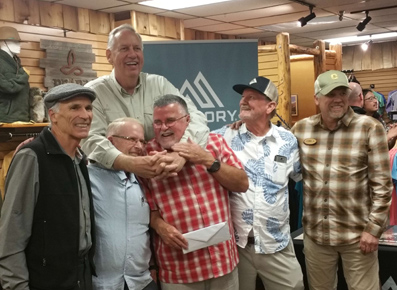
Meanwhile, A16 under Mic Mead continued successfully right up to recently (add date). More recently, Mic Mead retired from the company and his nephew John D. Mead was the Company President (see John in plaid shirt on right side of recent picture). In any case A16 has now ended its long and inspiring career. At its height it was Southern California-based, with seven retail stores. Picture: famous packmaker Wayne Gregory is in the center with a red plaid shirt; he was A16's second employee, joining Andy in 1965. Also in the picture is Steve Noall, between Wayne and John; Steve created Noall tents, often with strong support from Wayne). Notably, he worked with Andy and Wayne to bring the A16 dome to market.
.....Meanwhile (early 2009), Mr. Drollinger, now in his early 80s, is retired and lives near Sedona, Arizona. He's working on a number of projects related to the History of Gear and Backpacking. Errata: Drollinger's son was also named Ralph Drollinger, Jr., and became a well-known NBA basketball player, having, like his father, great height.(Ralph is the obviously tall guy in the picture)
.... In my final communication with Mr. Drollinger, late August 2012, he was 87 years old, and told me he was writing about the ergonomics of packs for heavy loads. He was living a "mobile" existence with a base in Sedona, Arizona. He was born January 13, 1925, in San Bernadino, CA and had Sedona as his address since about 1992. The picture below was shared with me by long-time correspondent Monte Dodge. It's Andy in 2010, attending the annual PCT pre-season hike festival in Southern California.
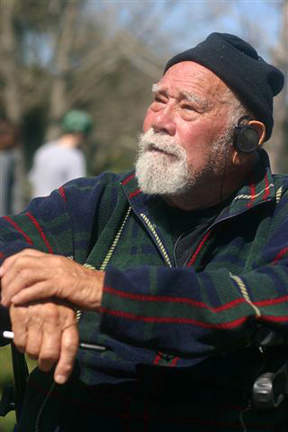
REST IN PEACE. Andy Drollinger passed away in the Spring of 2018 at age 93. I believe he was still in Sedona, AZ.
Remarkably different has been the business course of the small custom gearmaker Stephenson's Warmlite, which has survived, and never changed its name or ownership in 50+ years of doing business! Its Business Manager Jane Fortin was unchanged for decades! Update: Jack Stephenson passed away in early 2017. Warmlite was bought by his niece Kim Stephenson Cunningham, who has re-established it the State of Maine. (April 2021 news).
MY BOOKS:
Here's a link to a page displaying my ten books, including links to purchase them.
My first book was about Frostline Kits. Please visit my FROSTLINE PAGE (click here) for a link to order it, or to view a free 15 page PDF preview. The second book was released May 20, 2008 and is titled, "GERRY, To Live in the Mountains" (click here). The third book of the series was released in November 2009 and covers the story of Holubar Mountaineering. Since that time, I have published two additional books, one about Mountain Safety Research of Seattle (MSR), and the other about Stephenson's Warmlite Equipment....Later, I will pull together several of the smaller gear companies into one book, among them will be A16...... Please Note that my six books are also available as inexpensive PDF downloads ($15 apiece, direct from me, contact: brucej@Oregonphotos.com)

Andy knew another of Southern California's pioneering spirits. She's a little-known figure, a "gear" pioneer of a different flavor! Her name was Ann Benedict. She founded Dri-lite Foods.... Andy knew her from his days as a Boy Scout leader, where the advent of these new-fangled freeze-dried foods was a dazzling new "gear innovation" in the late 50s and early 60s. Sore-shouldered Scouts on camping merit excursions welcomed the radical decrease in weight and bulk that these new camping foods brought into their lives! In a somewhat later timeframe, an Oregon-based company became more prominent in the minds of the young backpackers of the later 60s and 70s, and that was Mountain House Foods of Albany, Oregon (and still based there in 2022).