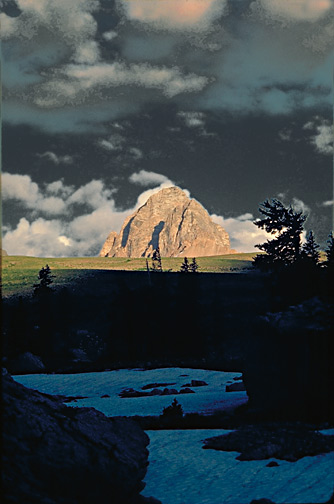
 12,000 ft. Buck Mountain, from Alaska
Basin
12,000 ft. Buck Mountain, from Alaska
Basin12,000 ft. Buck Mountain, from Alaska
Basin
(see below for Important Gear Pioneers, and link to The History of Gear Project's Main Page)
In the silence, a distant rock clicked from somewhere among the barren boulders on Buck's summit pyramid. I startled, was there someone else up here where I had seemed so alone and close to God?
Worse than a fellow climber, the shape that appeared around the mountain's shoulder was inhuman, with two large, massive horns, and four hooved feet. In the alpine meadows far below I had seen three elk, but this could not be an elk. Not this high.
It took me a moment to grasp the reality. I was less than sixty feet from a very large Rocky Mountain Bighorn sheep, probably a ram. I was alone, and he was alone. No one would ever know if he butted me off into the oblivion nearby on the mountain's awful north face. I stood quietly in the thin air, surveying my fate. Mr. Bighorn did the same, and then moved in utter quiet, suddenly vanishing like smoke over the mountain's shoulder. When I climbed to that place, there was no sign, no sign of his passing, nothing remaining upon the great peak.
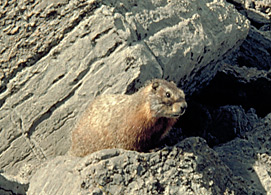
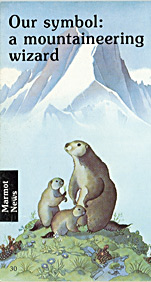
The marmot is the quintessential mountaineer's companion, found all over the alpine ranges of the West. This one was eyeing us from his impenetrable rock haunt near Death Canyon Shelf. The size of these guys takes you by surprise as they bask in the sun among the giant-size rockslides of the Tetons. When this one waddled leisurely across a small meadow, we were amazed to see that he or she was as big as a medium size cat! John Muir (1838-1914) wrote an elegant piece about the Sierra marmots and their life amongst the highest Sierra peaks..... Many years later, Marmot Mountain Works, founded on April 1, 1974 in Grand Junction, Colorado, had an extensive quote from Muir about the animal, their namesake... Please go to page bottom for the complete text of John Muir's wonderfully thoughtful writing about the marmot, and see a beautiful marmot painting from the 1977 Marmot Mountain Works catalog.
 E-mailer: brucej@Oregonphotos.com
-- or click to query Bruce Johnson, author of the above story
E-mailer: brucej@Oregonphotos.com
-- or click to query Bruce Johnson, author of the above story

"...(the marmot) dwells on high bleak ridges and boulder piles; and a very different sort of mountaineer is he-- bulky, fat, aldermanic and fairly bloated at times by hearty indulgences in the lush pastures of his airy home. And yet he is by no means a dull animal. In the midst of what we regard as storm-beaten desolation, high in the frosty air, beside the glaciers he pipes and whistles right cheerily and lives to a good old age. If you are as early a riser as he is, you may ofentimes see him come blinking out of his burrow to meet the first beams of the morning and take a sunbath on some favourite flat-topped boulder. Afterward, well warmed, he goes to breakfast in one of his garden hollows, eats heartily like a cow in clover until comfortably swollen, then goes a-visting, and plays and loves and fights.
 "In
the spring of 1875, when I was exploring the peaks and glaciers
about the head of the middle fork of the San Joaquin (river),
I had crossed the range from the head of the Owen River, and one
morning, passing around a frozen lake where the snow was perhaps
ten feet deep, I was surprised to find the fresh track of a woodchuck
(marmot) plainly marked, the sun having softened the surface. What could
the animal be thinking of, coming out so early while all the ground
was snow-buried? The steady trend of his track showed he had a
definite aim, and fortunately it was toward a mountain thirteen
thousand feet high that I meant to climb. So I followed to see
if I could find out what he was up to. From the base of the mountain
the track pointed straight up, and I knew by the melting snow
that I was not far behind him. I lost the track on a crumbling
ridge, partly projecting through the snow, but soon discovered
it again. Well toward the summit of the mountain, in an open spot
on the south side, nearly inclosed by disintegrating pinnacles
among which the sun heat reverberated, making an isolated patch
of warm climate, I found a nice garden, full of rock cress, phlox,
silene, draba, etc, and a few grasses; and in this garden I overtook
the wanderer, enjoying a fine fresh meal, perhaps the first of
the (spring) season. How did he know the way to this one garden
spot, so high and far off, and what told him that it was in bloom
while yet the snow was ten feet deep over his den? For this it
would seem he would need more botanical, topographical, and climatological
knowledge than most mountaineers are possessed of.".... Image is the front cover of the 1977 Marmot Mountain
Works catalog.
(Link to my main
Marmot page)
"In
the spring of 1875, when I was exploring the peaks and glaciers
about the head of the middle fork of the San Joaquin (river),
I had crossed the range from the head of the Owen River, and one
morning, passing around a frozen lake where the snow was perhaps
ten feet deep, I was surprised to find the fresh track of a woodchuck
(marmot) plainly marked, the sun having softened the surface. What could
the animal be thinking of, coming out so early while all the ground
was snow-buried? The steady trend of his track showed he had a
definite aim, and fortunately it was toward a mountain thirteen
thousand feet high that I meant to climb. So I followed to see
if I could find out what he was up to. From the base of the mountain
the track pointed straight up, and I knew by the melting snow
that I was not far behind him. I lost the track on a crumbling
ridge, partly projecting through the snow, but soon discovered
it again. Well toward the summit of the mountain, in an open spot
on the south side, nearly inclosed by disintegrating pinnacles
among which the sun heat reverberated, making an isolated patch
of warm climate, I found a nice garden, full of rock cress, phlox,
silene, draba, etc, and a few grasses; and in this garden I overtook
the wanderer, enjoying a fine fresh meal, perhaps the first of
the (spring) season. How did he know the way to this one garden
spot, so high and far off, and what told him that it was in bloom
while yet the snow was ten feet deep over his den? For this it
would seem he would need more botanical, topographical, and climatological
knowledge than most mountaineers are possessed of.".... Image is the front cover of the 1977 Marmot Mountain
Works catalog.
(Link to my main
Marmot page)
Learn about The Backpacking Revolution, which I also title "The History of Gear, 1935 to The Present." This already has grown to over 45 pages, including six published books. The project focuses on some of the energetic pioneers of outdoor gear, those dreamers who utterly changed the stuff we wear, the shelters we use, and our outdoor survival tools, such as ice axes and mountain stoves.
Prominent Names in the History of Gear
(this is an ever-growing list of people and gear companies. Here is a Link to an alphabetized version of the list below, minus many of the pictures). Otherwise, please continue below.
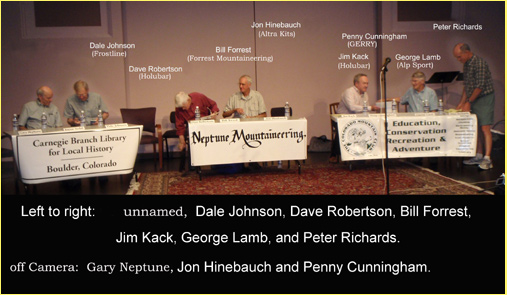
Image above, Notes re: in July of 2008, a historic reunion was held in Boulder, Colorado. Presenting were many pioneers from (mainly) the Colorado scene, circa 1945-1980). From left to right: Dale Johnson, founder of Frostline. Bill Forrest, founder Forrest Mountaineering; Jon Hinebauch, founder Altra Kits; Jim Kack, President of Holubar; George Lamb, founder Alp Sport and Camp 7, also involved with Alpine Designs, as was Jon Hinebauch. Penny Cunningham is the daughter for the founder of GERRY Mountain Sports.
Holubar Mountaineering, Alice and Roy (LeRoy) Holubar of Colorado (pictured is Jim Kack, who bought Holubar from the founders in the late Sixties and turned it into a huge business success; Gerry Cunningham of "GERRY" in Colorado (Penny Cunningham, daughter of Gerry, was at the conference but isn't in the picture); Bill Forrest of Forrest Mountaineering; George Lamb, who worked with GERRY in the very early days and then formed three companies of his own (in order) Alp Sport,Alpine Designs, and Camp 7; Dale Johnson, a long-time partner with Gerry Cunningham who formed his own highly successful kit company Frostline Kits in 1966; Jon (Jonathan)Hinebauch (not in the picture) who formed the highly successful Altra Kits of Colorado. Todd Bibler tents since 1977, originally from Colorado.
Jack Stephenson of Warmlite in California/New Hampshire; Bob Gillis of Shelter Works in California; George Rudolf and designer Allen Steck of Ski Hut/Trailwise in Berkeley, Califorinia; Mark Erickson, Head Designer for many years at The North Face in the San Francisco area of California; Wayne Gregory and Dick Kelty of California; Steve Noall of Noall Tents of California; Bob Swanson and George Marks of Sierra Designs; Justus Bauschinger of Ski Hut who went on to be a major part in the stories of several other companies such as first North Face and later, in 1971, Class Five; Noah Lamport of Hobie Cat fame; Eric Reynolds and his designer George Hundley of Marmot; Snowlion; Carikit (Holubar Kits) of Boulder; Larry Penberthy's Mountain Safety Research (MSR) of Seattle, Feathered Friends of Seattle since 1972; Crescent Down Works of Seattle since 1973; their down jackets and vests now available exclusively at J.Crew; JanSport (orginated near Seattle, founders Jan Lewis, Skip Yowell and Murray Pletz-Murray McCory).
W.L. Gore and Associates-- William
"Bill" Gore and his son Bob--- Bob who almost by accident
discovered expanded PTFE, went on to learn how it could be applied
as a membrane to outdoor fabrics, thus creating what we know as
Goretex, in 1976 reaching use in outdoor tents and garments. Bill,
a renowed chemical scientist, passed away in 1986, and in Fall
2020, sadly, his son Bob Gore passed away. Thank you for everything,
Bob! Gore and his son Bob,  Goretex
Caribou Mountaineering; and tiny little custom companies like Down Home of Arcata, Calif./Deadwood, Oregon (Denice and Chuck Kennedy); Banana Equipment Company of Estes Park, Colorado; Mountain Products Corporation (MPC) of Wenatchee, Washington; Bill Nicolai's "Early Winters Co." (his tent the "Light Dimension" in 1976 was probably the World's first tent utilizing Goretex, and his 1976 mountain shell parka is reputed by some to be the World's first outdoor product using Goretex); Danner Boots of Portland, Oregon since 1932; Dana Gleason and Renee' Sippel-Baker of Kletterwerks (1975), which then became Dana Designs (early '80s), which was the well-known predecessor of the current pack-making company "Mystery Ranch." Black Diamond (tents@bdel.com) which is the employee-owned successor to Chouinard Equipment Company which formed Dec. 1989, after the original Chouinard went bankrupt shortly before..Ann Benedict of Dri-lite Foods, a gear pioneer of a different sort, introducing freeze-dried foods to the campers of the late 50s.
More important names and companies include.tiny little custom companies like Down Home of Arcata, Calif./Deadwood, Oregon (Denice and Chuck Kennedy), Blue Puma, and the formerly tiny Moonstone Mountain Equipment, also of Arcata, CA. The list goes on to include: Dick Kelty of Kelty Packs; Sierra West of Santa Barbara, CA, which Dick Kelty's son Richard Kelty tells me was co-founded by he and Rick Scott in 1971 (both men also part of "Big Dogs" company); Wilderness Experience (WildX) of Chatsworth, Calif., founded in 1973 by the brothers Jim and Greg Thomsen, re: WildX the very good news is that Jim has put together a history website about his company, click to visit his pages; also of Santa Barbara was Granite Stairway Mountaineering, which produced a good-looking clone of the Rivendell Jensen originals....Also in that area of California was Caribou Mountaineering of Chico, Calif....One of my own personal favorites among the classic companies was Rivendell of Idaho/Wyoming (Larry Horton and currently Eric Hardee); Powerhorn Mountaineering of Jackson, Wyoming, the Carmans of Life Link in Wyoming. Below is a picture I took up in Paul Petzoldt's home range, the 100 mile long Wind River Range of central Wyoming. Petzoldt's home base for many years was small town of Lander on the Wind's south easterly flank; he manufactured and imported gear especially suited to the extreme altitude and cold of the Winds.
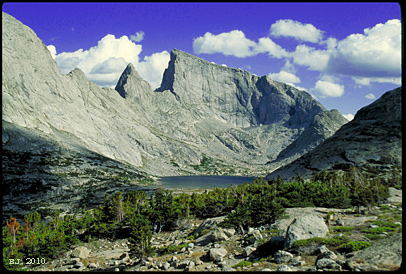 12,500 ft.
More gear Pioneers-- Patrick Smith of Mountainsmith packs and sleds; Himalayan Industries, of Monterey, CA. on Cannery Row; Daniel Sherman's Synergy Works of Oakland,CA, later sold to Ken Koerwitz; Denali/Mountain Master packs; Ocate' foam bags/CosyQuip; Pivetta boots of Italy, such as the Pivetta 7, 8 or Eiger, imported by a Trailwise off-shoot called DMC, Donner Mountain Company; in Montana, Kletterwerks which in 1985 became Dana Designs and is as of 2000 renamed as Mystery Ranch; In the Northeast (Maine) since 1975, let's not forget Bill Moss and Moss Tents-- Moss is the artist-engineer-architect guy who invented the first "Pop-up" tent in 1955, but now his firm has moved on to "Tensioned fabric solutions," a new Moss catch-phrase that marked their move out of the retail tent business in the mid-90s. ; Yak Works of Seattle (Don Wittenberger); Plain Brown Wrapper kits, and Andy Drolinger/Mic Mead's A16 of Southern California. Sling Light Chairs of California, popularized in the Warmlite Catalogs; Don Douglas of Alpenlite Packs in California (may be spelled Don Douglass)... Bill Dolt gear, and the Dolt Hut catalog of 1960, I think Warren Harding was behind that company, and also he authored the short-lived "Descent" magazine, a notorious foil to the AAC's prestigous "Ascent" magazine.....And don't forget Western Mountaineering, which still makes great, Made in the USA, down bags and other gear out of San Jose, California.
On the other side of the Atlantic, in Europe, I include Hilleberg Tents of Sweden. (Bo Hilleberg, founder in 1970-73, with first production tent, the Keb, in 1973). This family business has greatly expanded, with son Rolf now running most operations in Europe, while daughter Petra Hilleberg has moved to the Pacific Northwest and is running most US operations. I have met Petra personally. Key innovations have been the connected inner and outer tents, and the use of a new silicone-coated fabric that is six or seven times stronger than most usual tent fabrics (trade name is "Kerlon").
I am also including Leon Akers,
(Akers of Maine) because he was one of the very first to popularize
cross-country skiing  in
America; in 1967 his store was virtually the only place in the
USA where we at the University of Oregon Outdoor Program were
able to purchase the gear that allowed us to begin the cross-country
ski program!.(interview with Bob Woodward).... Among those gear
brands, and still existent today, is "Odlo" of Norway.
Others were Jarvinnen skiis, and Alfa boots.
in
America; in 1967 his store was virtually the only place in the
USA where we at the University of Oregon Outdoor Program were
able to purchase the gear that allowed us to begin the cross-country
ski program!.(interview with Bob Woodward).... Among those gear
brands, and still existent today, is "Odlo" of Norway.
Others were Jarvinnen skiis, and Alfa boots.
The two logos below will lead you to webpages with much detail about Rivendell and Frostline, and then you'll find links to many more of my pages about many of the above classic gear companies.
 image
image image
image