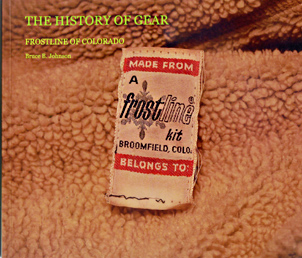
BOOK: "FROSTLINE OF COLORADO" My 66 page book details the history of the company from before its founding in 1966 up through its final death in Grand Junction, Colorado some forty years later. The book is available in either softbound or hardbound, both versions in an 8x10 format, lushly illustrated with pictures and catalog scans. The same book is also available as an inexpensive PDF download for $15. The book begins with a FORWARD BY DALE JOHNSON, THE FOUNDER OF FROSTLINE KITS. There are also many FUN GEAR REPORTS FROM LONG-TIME USERS. Please click on the picture of the book cover below, which will take you to my publisher Blurb Books, where you can order the book, or inspect a free 15-page book preview... Alternatively, you can contact me (jupiterman47@gmail.com) directly to obtain the book as a $15 PDF download..... If interested in an autographed copy, the hardback or softback book needs to be shipped twice and will cost somewhere between 10% and 25% higher price, depending on your location. Click for a Book Review. Click for my discussion of my pricing and quality. Click for my Writer's Biography.
 click
click"FROSTLINE OF COLORADO," By Bruce B. Johnson. PLEASE CONTACT ME (jupiterman47@gmail.com) IF YOU HAVE QUESTIONS, OR EXPERIENCE ANY DIFFICULTY ORDERING THE BOOK ON MY PUBLISHER'S WEBSITE. Note: Also now available are other books in the History of Gear series: "GERRY, To Live in the Mountains," "MSR, Defying Tradition, "Warmlite: Still Controversial After All These Years," and, "Holubar Mountaineering Ltd.," please click for details.
Also, please take a look at a short and very modernized site that I've recently created that focuses on all six of my books; it's a short alternative to the vast detail offered in my main pages below: see, www.historyofgear.weebly.com
Please Note: All Material on this page, and in all my "History of Gear" webpages, is copyrighted, and no usage of my material is permitted unless explicit permission is granted by me, Bruce B. Johnson, owner of OregonPhotos.com. Sources used to develop this material include interviews with Frostline founder Dale Johnson and also an interview with the Frostline owners who took over circa 1983. I've also spoken with many ex-customers and some of the contract sewers that Frostline used. I myself visited the Frostline store in the Portland, Oregon metro area in the later 70s. I welcome readers contacting me (jupiterman47@gmail.comoregonphotos.com) with information, pictures or stories about Frostline Gear, or any other of the classic outdoor companies.
 Date:
1966, Boulder, Colorado.. Dale Johnson (no relation to this writer)
became possessed with the cheerful vision that common folk could
produce high-quality outdoor gear on their own home sewing machines
of sufficient quality to take into the high mountains backpacking,
climbing and hiking. Mr. Johnson's involvement with Frostline
ended in 1978, after over ten years of booming growth and success.
The company he began continued, and for over 30 years this (mostly)
mail order business nurtured many of us (often poor) outdoor types.
Dale, age 76 in 2008, continued to live in Colorado, and continued
his active life of backpacking and backcountry skiing with his
wife. He even still had full sewing facilities at his home, and
whipped himself up a new tent now and then. (source: personal
interviews with Dale in early 2008). On February 23, 2012, Dale
Lloyd Johnson passed away in Boulder. Another of the great Pioneers
now gone.
Date:
1966, Boulder, Colorado.. Dale Johnson (no relation to this writer)
became possessed with the cheerful vision that common folk could
produce high-quality outdoor gear on their own home sewing machines
of sufficient quality to take into the high mountains backpacking,
climbing and hiking. Mr. Johnson's involvement with Frostline
ended in 1978, after over ten years of booming growth and success.
The company he began continued, and for over 30 years this (mostly)
mail order business nurtured many of us (often poor) outdoor types.
Dale, age 76 in 2008, continued to live in Colorado, and continued
his active life of backpacking and backcountry skiing with his
wife. He even still had full sewing facilities at his home, and
whipped himself up a new tent now and then. (source: personal
interviews with Dale in early 2008). On February 23, 2012, Dale
Lloyd Johnson passed away in Boulder. Another of the great Pioneers
now gone.
If your main question is, "Can I still order Frostline Kits," please skip to Page Bottom for the latest on this mysterious subject!
If your main interest is in finding MODERN companies which can supply you or fix your old gear:
Please click here to visit my page about where to buy outdoor fabrics and down. That page also includes advice regarding such topics as Urethane coatings break-down, mildew, and my "Essay on Down," re: washing of down sleeping bags, the origins, care and storage of down gear! You will find a wonderful BOOT CARE guide from Randy Merrell Boot Company here.
Please visit this page if its repairs you are seeking, eg. you've got a piece of gear that needs quality repairing, please click here to visit the page that I've compiled about that important subject, including tent pole repairs!
For a brief summary of Frostline Company History, skip to here.
The name brings back a flood of memories: A flame of a fierce independence; a joy in a creativity that won't allow itself to be "bound by a box." Fun with other sewing nut friends caught up in a gear-making Revolution. And a special pride in owning and showing off great, personalized gear despite being a college kid and young adult on a very small budget.
That was the Frostline
draw: To make your OWN gear, to customize it as much as one had
the imagination and perserverance to try. To add your name, to
add those perfect pockets you always dreamed of onto that daypack
that is lacking; in fact, to add all manner of hardware/software
anytime, anywhere, to anything you can sew or glue it to!
Then there was that insane pleasure of taking a plump tube of
down and secretly boosting the warmth of your existing climbing
parka, and the cry of dismay from the surprised spouse who arrived
home and discovered the living room atmosphere alive with tiny
white down clusters! (the Frostline down-filling technique took
some time to develop expertise in using!). Click here for a
story about the
ultimate joy of building one's own gear!
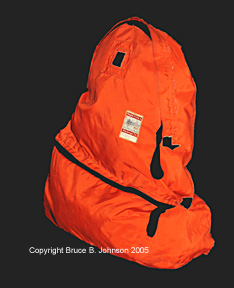 My
personal kit-building successes included: a "Bighorn"
down sleeping bag, a shell parka or two, a down vest or two, a
dog pack, a fine 3-man tent, I think called the "Ridgeline,"
a bright orange teardrop daypack, a pair of red gaitors, two pair
of insulated winter pants, and probably a few more creations that
I have forgotten...... Most of these exited my sewing room with
several alterations and additions to customize them to ME, my
spouse, or my DOG. In the most radical cases, I would even buy
a garment kit and then completely replace the inner or outer material
with stuff of exotic colors, a more pleasant "hand,"
or even add a hood to a kit that lacked one, using the design
from a previous kit I had sewn! Some of these kit creations I
still have and use today, such as the classic daypack shown to
the left, now truly a piece of vintage gear to be cherished! (Image
copyright Bruce B. Johnson 2005).
My
personal kit-building successes included: a "Bighorn"
down sleeping bag, a shell parka or two, a down vest or two, a
dog pack, a fine 3-man tent, I think called the "Ridgeline,"
a bright orange teardrop daypack, a pair of red gaitors, two pair
of insulated winter pants, and probably a few more creations that
I have forgotten...... Most of these exited my sewing room with
several alterations and additions to customize them to ME, my
spouse, or my DOG. In the most radical cases, I would even buy
a garment kit and then completely replace the inner or outer material
with stuff of exotic colors, a more pleasant "hand,"
or even add a hood to a kit that lacked one, using the design
from a previous kit I had sewn! Some of these kit creations I
still have and use today, such as the classic daypack shown to
the left, now truly a piece of vintage gear to be cherished! (Image
copyright Bruce B. Johnson 2005).
The early Frostline gear line-up included all the basics such as parkas, tents, and sleeping bags, and, over the years, expanded to include many related items, for example my Fall/Winter 1995 catalog lists such items as soft luggage, bicycle panniers, short pants, tote bags, and a growing line-up made of the trendy new material called "pile" (which of course has gone on to revolutionize outdoor clothing wardrobes).
NOTIONS: Frostline also offered a wonderfully extensive collection of raw materials and "notions;" eg. every kind/color of nylon you could dream of, zippers, tubes of down, buckles, zippers, drawstring clamps, snaps and grommets--- you name it and you could buy it and get to work revamping those inadequate non-Frostline products.
Several of us amateur
designers went beyond cosmetic alterations and explored new concepts
of warmth, strength and design. I, for instance, still have and
use a pair of baffled down pants which incorporate a vapor barrier
and a sitting zone composed of less-compressible polarguard....
Did I form a company of my own and sell ten thousand of them and
patent the idea? No, but what fun I had, and others actually did
go on to enter careers designing gear within the growing outdoor
products industry of the 70's and 80's; as an example, Wayne Gregory
worked running a Frostline store for Dale Johnson in about 1976.
It was in Newport Beach, Caifornia. This was before Wayne launched
Gregory Mountain Products in 1977 (click for more re: Wayne's history).
Frostline spawned a generation or two of GEAR CREATORS, and this
is one of the Company's big contributions to the Gear Revolution......
Frostline also spawned a huge collection of assorted imitators.
Some of these kit companies (eg. Altra, Camp 7's Calico Kits,
and Holubar's Carikits) were neighbors right in the Boulder/Denver
area, while others sprung up all over the U.S, most during Frostline's
prime years (1970-1980).......
the list is long,
and is found below.... An interesting sidelight is the fact that
one of the very earliest kit companies did not produce clothing
at all-- it was a branch of Andy Drollinger's A16 pack company which produced a "Do it yourself, External
Pack Frame Kit" in the early 1960s, mostly sold to BSA troops
(Boy Scouts of America).
FROSTLINE KITS was
founded in 1966 by Mr. Dale Johnson, in Boulder, Colorado; however,
both Dale and his wife Julie Johnson had been in the Boulder outdoor
equipment scene for several years already, most prominently with
GERRY MOUNTAINEERING. Mr. Johnson had learned the business after
graduating college
in Boulder and entering
into an approximately 5 year long business relationship with the
pioneering outdoor company "GERRY
Mountaineering,"
and its innovative owner, Mr. Gerry Cunningham.. Frostline's first
real catalog was mailed in 1967, a simple affair with photos and
text in light blue, sporting a tent and sleeping bag on the front
cover. The Frostline kits were an immediate hit, and the Company
constantly grew and expanded, adding both retail locations, and
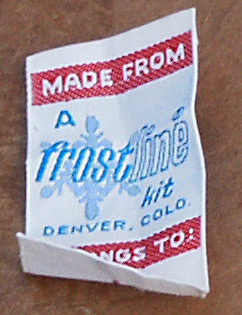
expanded manufacturing plants; thus, collectors find sew-on Frostline
labels that show three different locations: the earliest "Boulder,"
the next "Broomfield" and the last "Denver."--
The businessmen of the equipment kit industry all tried their
best and some like Dale just happened to get out at the right
time.
COMPANY PICNICS! Frostline as an employer was so loved by its employees, reports Founder Dale Johnson, that for years after the original company under Dale Johnson had dissolved, its former employees were still holding annual "Frostline" picnics!
The outdoor equipment kit industry thrived for over a decade, reaching its high point in the later 1970s.. One source states that between the two big kitmakers (Frostline and Holubar/Carikits) sales approached 50 million dollars annually (this is a figure that I question)..... Frostline boomed with sales doubling every year for some ten years. For Frostline, their kit catalogs were extremely successful, and eventually there were also 18 Frostline retail stores. Mr. Johnson ran Frostline until 1978. At that point, the company was still a great success. Dale stated proudly, "I sold it at the perfect time." He sold to a big corporation--- the "Gillette" of razor blade fame. But the growth bubble was soon to pop.
Under Gillette management, Frostline did not do well. In addition, several insidious factors had developed in the American economy that were a real challenge to Gilette. By 1982, Gillette tried to sell Frostline, but there were no buyers, and so Gilette liquidated Frostline in 1983 (source: Dale Johnson interviews). Dale reports that a customer in Grand Junction, CO learned of the liquidation, bought the remaining assets of Frostline, and tried to start over (the buyers were Eddie and Shirley Clements, who filed new business papers with the State of Colorado February 1984). But, according to Dale, the "new" Frostline suffered a long period of hard times and declining fortunes. ..For one thing, the extensive Frostline production facilities had long since been eliminated, and the manufacture of any new kits was very problematic from a number of standpoints...... the company's location as Grand Junction, in Western Colorado, hundreds of miles west of its original location.
Why would such a booming
market for kits collapse?
I myself had stopped buying kits during the 80s; but I always
assumed Frostline was going strong, and was nurturing along another
generation of enthusiastic kit builders. Unfortunately, I was
wrong; ever since the late 1970s, the kit market
had been going downhill.
According to Dale Johnson and a top Holubar/Carikits person, the
main reasons were that economic hard times in the 1980s were forcing
more and more American women (the main market for the kits was
always women, not the occasional nut-case men like myself) to
take up "real" jobs, therefore with less time and energy
for kit-building. Secondly, cheap outdoor goods from
abroad (chiefly the Orient) began to pre-empt 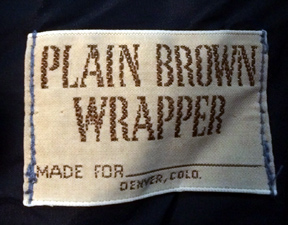 a
big segment of the Frostline-Holubar kit market, mostly, I would
guess, that segment who were buying the kits to save money (as
opposed to those of us who bought the kits more to innovate, create
and modify gear for hard-core mountain and expedition use). In
any case, both Frostline Kits and Holubar kits went bust somewhere
in the early 1980s timeframe....
a
big segment of the Frostline-Holubar kit market, mostly, I would
guess, that segment who were buying the kits to save money (as
opposed to those of us who bought the kits more to innovate, create
and modify gear for hard-core mountain and expedition use). In
any case, both Frostline Kits and Holubar kits went bust somewhere
in the early 1980s timeframe....
Along with these two giants, nearly all of the numerous smaller kit companies also bit the dust, the many examples include: Altra Kits, Makits, Country Ways (at least their Frostline-like products), Cascade Kits, Calico Kits by Camp7, Colorado Sunkits, Kangaroo Kits of Epsom, NH, Rainbow Country Kits of Northglenn, CO, Sierra-Cascade Kits of (surprisingly) Glen Cove, NY, Sundown Kits, EMS Kits, REI Kits, Symmetry Kits of Vermont, Timberline Sewing Kits of New Hampshire, The Daisy Kingdom ski wear kits, and Plain Brown Wrapper Kits out of Denver, Colorado (that's 16 smaller companies!).
1966. Founded by Dale Johnson in Boulder, Colorado. By the early 1970s, the Company is vastly expanded and has a big manufacturing facility in nearby Broomfield, Colorado.
1978. Dale Johnson sells the company to Gillette Corporation. Now Frostline has a huge, modern factory headquarters in Denver, Colorado.
1983. Approximate date when Gillette sells off its Frostline holdings.
1984. Company trademark and many goods and manufacturing supplies bought from Gillette by a small group of investors in Grand Junction, Colorado that included Eddie and Shirley Clements, Tom Conner as President, and Dave Canaday. Grand Junction is hundreds of miles west of the company's original location in Boulder, on the other side of the Rocky Mountains. On 2/15/1984, it's legal name became "Frostline U.S.A., Inc." and it's new version of the Frostline label often (not always) included the word "Insport" (Insport was described as "an employee owned company")...
1994 (approx.) a brief business arrangement with McCall Patterns.
2000. The company has failed and is bought up at the last minute by Bob and Catharine Flowers of Grand Junction, Colorado. It's new legal name became "Frostline Kits USA, LLC."
2001. The Flowers issue the first new catalog in years. This new catalog becomes the last-ever Frostline catalog.... Frostline remains in the Grand Junction, CO area, in the very town that was the birthplace of Marmot Mountain Works (see link), and is also the long-term home of Jerry Wigutow's company, WIGGYS, the supplier of Lamilite bags and jackets.
mid-2010. The apparent final end of the Frostline. Most reports indicate that for all practical purposes, the company had ceased to function 1 to 3 years prior to this time.
February 23, 2012. Dale Lloyd Johnson, founder of the original Frostline Kits company, passed away in Boulder, Colorado.
2010-2015: As of July 2010, the last known owner of Frosltine Kits moved far away from the company's Grand Junction location. As of September 2016, there is continued convincing evidence that Frostline as a maker of outdoor sewing kits is finally gone for good. I will continue to post updates whenever I hear more. READERS: PLEASE HELP ME COMPLETE THE FROSTLINE STORY. IF ANY OF YOU LEARN MORE, PLEASE EMAIL ME (jupiterman47@gmail.com).

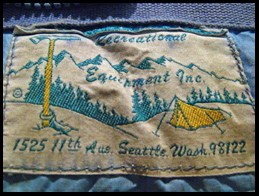 Classic Labels
I am developing a page full of classic, old equipment labels and readers are welcome to contribute. The link to that page is below.
The REI label to the left is a classic, representing one of the first companies in the USA to supply climbers and backpackers: this REI label dates from sometime in the 1960s, well before the era when the little climber's cooperative of Seattle exploded into the corporate giant named Recreational Equipment Inc...Click here for my REI page.... You'll note the tent shown is a primitive guy-lined A-frame, and the ice axe is wooden-shafted and with the old-fashioned pick/adze-- the axe in particular is a sign that this label dates from well before REI's neighbor in Tacoma had perfected the metal-shafted axe (Larry Penberthy's MSR, aka Mountain Safety Research). (image contributed by Monte Dodge). Click here to visit my page of classic, old equipment labels.
 Now Up and Running!
Note: there has not been a cold wave in Oregon to fully equal the Dec. 1972 cold wave that is the subject of this story. Only 1989's cold wave sent the mercury lower in Oregon, but that cold wave in some respects was not as severe or widespread. And with Global Warming an acknowleged reality, 1972's cold wave will probably never be equalled again (see gear-making story below).
We stood staring at the block of ice filling the toilet in the bunkhouse. Dave puffed frosty clouds of vapor as he exclaimed, "You're insane, why don't you come stay at my Mom's place with me until this is over, it's already zero, and the radio says it's going to get a lot colder!" We had worked together for two months, trail-building under harsh late-fall conditions, but now his voice had an edge to it that I had never heard before.
How could he know that there at Allingham Guard Station I was struck by the spark of a great adventure before me? "You go, I'm staying," I said decisively, and we went our separate ways. He pulled his few belongings off his bunk and with a "Good Luck," he was gone. Brillant sun streamed through the trees, and steam rose off the swift Metolius River nearby as I set to work gathering together all my camping and backpacking gear from the bunkhouse's closets.
As I drove up the River a few miles to my chosen campsite among the big ponderosa pines, my car radio was ablaze with warnings about the worst arctic cold wave to hit the Central Oregon High Desert in decades."Twenty below" by tomorrow morning the announcers all proclaimed. But I was not frightened, I was excited to test my gear against such odds! I had sewed custom gear! What a chance! There was the sleeping bag overbag that I had constructed that needed testing! There were my heavily-modified Frostline down pants, now fully-baffled, and with the vapor barrier interiors and full-crotch zippers. And of course the cozy warmth from the 4 oz. extra down I'd stuffed into the top-side baffles of my REI sleeping bag would be a pleasure of the highest order! So what if I would be alone for five frigid days, 5 miles to the nearest help at the Camp Sherman store? All loneliness was dispelled by the simple joy of watching flashing rainbow ice crystals floating down out of a deep blue sky. And the fact that it actually did hit 28 below zero on the coldest night was just more excitement! My customized gear worked great!
Story copyrighted Bruce B. Johnson 2007-2024