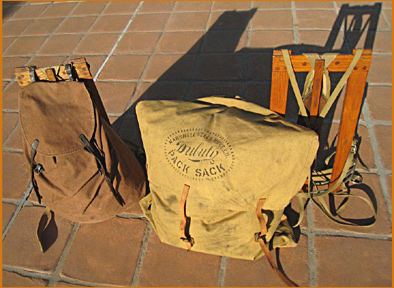
Segen Pax, Eugene, 1975-1980,
founded by Ed Segen and Tommy Bonfietti, two friends from Connecticut.
"Segen Pax."--- Their handcrafted packs featured elegant
laminated hardwood frames, beautiful leather appointments and
the best "organic" old tech materials like cotton duck,
while modern materials and concepts were tastefully used where
needed, eg. in zippers, buckles, etc. 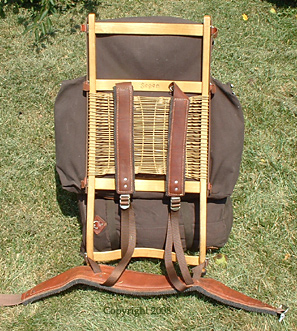 The
comany's tagline was "Advanced Simplicity" and the pack
was touted as a "Natural Pack." Here is one picture,
from contributor Terry, and below is from contributor Peter I.,
who lives in Southern California. ..he's a person who actually
owns and uses the Segen packs that he's acquired (yes, he owns
more than one!)
The
comany's tagline was "Advanced Simplicity" and the pack
was touted as a "Natural Pack." Here is one picture,
from contributor Terry, and below is from contributor Peter I.,
who lives in Southern California. ..he's a person who actually
owns and uses the Segen packs that he's acquired (yes, he owns
more than one!)
Peter wrote, "It is very hard to get any info on that company...and I have tried. I even had someone drive by the old address in Eugene [190 River Loop One, zip 97404], contact the Mazamas, the local Sierra Club chapter, called local gear suppliers in Oregon, etc. No one knew anything. I do remember seeing a color magazine ad on the internet. That gave some information. Glad you have included them in your research! Segen deserves special mention because they combined the vintage tradition of wood external frame & canvas rucksack with a modern hip belt suspension while staying true to the use of classic natural materials of wood, canvas, leather and wool felt. A very noble effort with true old school craftsmanship, even to the fact that the packs were made in a barn. Everyone who has seen one...their mouth drops open and they just say 'Wow!' 'What is that"? 'That is beautiful'... "
Eventually this author tracked down Mr. Segen and spoke to him on the phone in 2010. He was back in Connecticut, and using his woodworking skills to build a beautiful 19 ft. sailboat.
Peter went on to summarize:
"Segen almost seems to be a reaction to the modern era of synthetics, plastics, alloys and composites. A desire to put 'Mother Earth' back into the age-old recreational activity of backpacking. They did a fantastic job of establishing the 'Earth' connection in their product. I know they were not in the realm of modern technical mountaineering gear but what they produced, I feel, may be described as the most 'beautiful hand-made backpack ever'. The fact that these packs were made in Oregon should make every Oregonian proud. Their products are in the category of 'folk art' and exhibit the highest level of hand made craftsmanship."
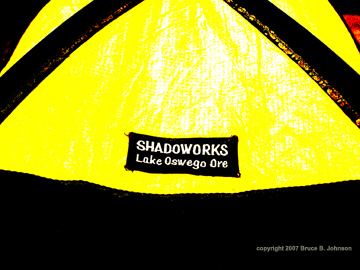
Shadoworks sprang up in Lake Oswego, Oregon, a few miles south of Portland city center. The company's slim 1982 brochure begins, "Paul Smythe, founder of Shadoworks, is an Oregonian, a mountaineer, and a bit of a perfectionist." The tent pictured here is owned by this author... Although I possess a 1982 version of the company's slim color brochures, I have discovered no further sources of information about this small gear company. Readers are invited to contribute what they know. The company was based in Lake Oswego, Oregon, a wealthy city within the Portland metro area.
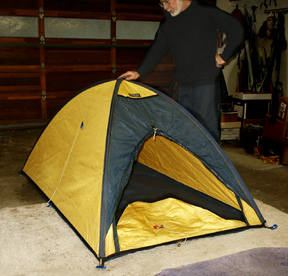 This
tent is the company's smallest model, the "DL 2," (the
Dry Light 2). The yellow parts are made of 1.5 oz. ripstop laminated
to Goretex, while the navy parts are made of a 2.2 oz. urethane
coated tafetta nylon. The pole sleeves are made of pack cloth,
and around the bottom perimeter is sewn a band of reinforcing
nylon webbing. This tent reminds me very much of a slightly down-sized
version of Todd Bibler's famed "I-Tent" model (Bibler
Tents, which went on to become much higher-profile than Shadoworks,
and much more expensive).... The DL 2 also reminds me very much
of the no-frills Integral Designs MK 1 Lite tent. Note: unlike
the Bibler tents, however, the DL2 sets up easily from the outside,
no need to get inside the tent.
This
tent is the company's smallest model, the "DL 2," (the
Dry Light 2). The yellow parts are made of 1.5 oz. ripstop laminated
to Goretex, while the navy parts are made of a 2.2 oz. urethane
coated tafetta nylon. The pole sleeves are made of pack cloth,
and around the bottom perimeter is sewn a band of reinforcing
nylon webbing. This tent reminds me very much of a slightly down-sized
version of Todd Bibler's famed "I-Tent" model (Bibler
Tents, which went on to become much higher-profile than Shadoworks,
and much more expensive).... The DL 2 also reminds me very much
of the no-frills Integral Designs MK 1 Lite tent. Note: unlike
the Bibler tents, however, the DL2 sets up easily from the outside,
no need to get inside the tent.
Specs: the DL 2 weighs
just under 4 pounds with 3 small metal pegs and 4 light pull-out
cords. I measured its floor as 80" long x 46" wide,
and the center height is a tight 35"- There are just two
aluminum, shock-corded poles and they fold to 20 inches long.
This tent has a kind of canopy over the front door, but no back
door, and nothing you could call a vestibule.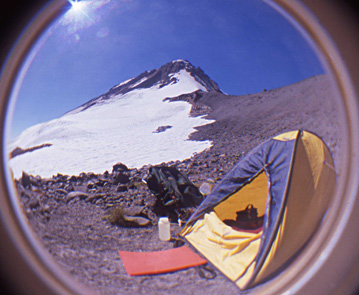
As can be easily seen
in the pictures, this is a very small tent indeed. In my personal
use of this tent I have concluded that it is too short to be comfortable
for anyone over about 5'8" in height. It would be a really
ideal tent for a small person taking a solo trek .... I'm not
sure how much I would trust the Shadoworks tent in severe rain,
especially severe rain with cold temperatures. Using a good spray
waterproofing on it before a trip, and thorough initial seam-sealing
help a lot. On the plus side, this tent is extremely quick and
easy to set up, even when one is very tired, wet or cold. It has
a very small footprint and requires no special soil or snow conditions
for stakes because it is self-supporting. And It is very strong,
and I would have no worries about a foot of heavy, wet snow falling
on it overnight while I slept. Under normal conditions, it is
freestanding, but using a few (2-5) small stakes can help maximize
interior room and wind-strength if needed. The very alpine picture
above was taken beside the glaciers of Mt. Hood at a place I prefer
to keep a secret.
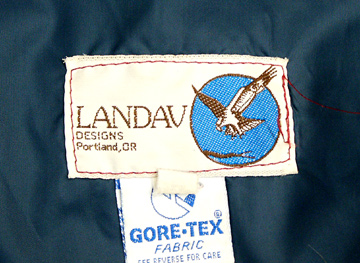
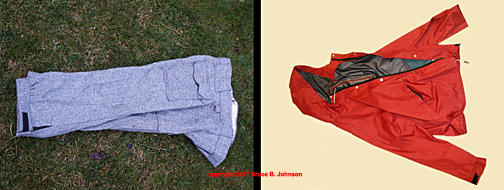
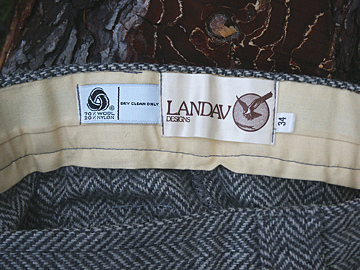
Landav Designs was Portland-based and specialized in garments of high class and high-quality. Illustrated are a goretex Mountain Parka and woolen knickers. Many of their products exploited classic materials with perhaps a modern update, as in my classy knickers, which are made of a very good-looking and very functional 70/30 blend of wool and synthetic (30% nylon, probably to improve performance in the typically wet conditions of the Pacific Northwest). I do not have a firm timeline on this company yet, and readers are invited to contribute what they know.
A part of the History of Gear relates to a distant era when there wasn't an REI in every larger town, and a Starbuck's on every corner.. I grew up in that deprived era in Oregon. This was a State far-removed from the great centers of gear pioneering in Boulder, Seattle, the Bay Area, and Los Angeles. When I was coming of Age in the mid to late-1960s, we had little to choose from, and if you did not live in Portland, Eugene, or Salem, you were forced to drive long distances to purchase modern climbing or backpacking gear.
In the Medford, Oregon of 1964, I had heard about the new sport of backpacking, but when I looked around the limited horizons of Southern Oregon, there was only "Lamports" (Lamport Sporting Goods).... And Lamports only stocked two kinds of packs-- the old wood-framed Trapper Nelsons, and the new-fangled aluminum frame ones with some kind of hipbelt and a canvas-like packbag...of course, I purchased the more modern one. This loyal pack lasted only two years, meeting its demise in 1966 when I placed it too near my campfire. Exhaustion was my excuse-- I had just climbed Mt. McLoughlin solo, and wasn't paying proper attention.
After I went away to
college in the more populous and progressive Willamette Valley,
I learned about Oregon's "Mountain Stores" from senior
members of the OSU Alpine Club. We took field trips to Corvallis,
Salem and Eugene, each of which had an "Andersons Sporting
Goods," 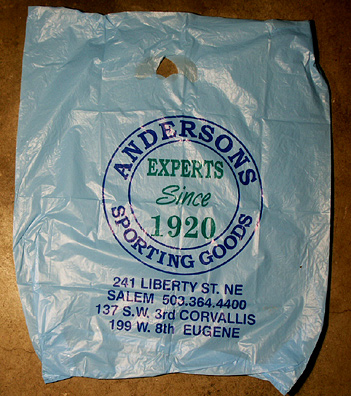 and 90
miles north in Oregon's largest city there were TWO Mountain stores
to visit! These were "The Mountain Shop," and the storied
"Cloud Cap Chalet" (named after a real historic place
high on Oregon's highest mountain (click for link)....Of course, in those days all the mountain shops
mostly supported themselves selling backpacking gear, outdoor
clothing, and often downhill skiing gear. (Interesting fact--
in 1968, the just-begun North Face company achieved its very first
sales when their new saleman Jack Gilbert sold some of the company's
very first products to Cloud Cap!)
and 90
miles north in Oregon's largest city there were TWO Mountain stores
to visit! These were "The Mountain Shop," and the storied
"Cloud Cap Chalet" (named after a real historic place
high on Oregon's highest mountain (click for link)....Of course, in those days all the mountain shops
mostly supported themselves selling backpacking gear, outdoor
clothing, and often downhill skiing gear. (Interesting fact--
in 1968, the just-begun North Face company achieved its very first
sales when their new saleman Jack Gilbert sold some of the company's
very first products to Cloud Cap!)
THE MOUNTAIN SHOP was founded in 1937, a year before the founding of REI in Seattle. In 2010, it's still alive and well, still independent, and still serving Northwest climbers, backpackers and other outdoorspeople after all these years. It likely hold's Oregon's title as the State's oldest still existing Mountain store. (www.mountainshop.net, at 628 NE Broadway in Portland, zip 97232).
As my training with the OSU Alpine Club advanced, soon I needed to rent crampons and an ice axe for my first real climb. That gear I rented from Anderson's in Eugene. Later that year, in mid-May, my graduation from snow-climbing school saw me on an adventure to climb Oregon's highest peak, 11,245 ft. high Mt. Hood. We stopped in Portland the day before, visiting the legendary Cloud Cap Chalet on 12th St. in city center. Black and white photos of famous climbs and climbers emblazoned the walls, many of them autographed... I rented ice axe and crampons, soaked-up the authentic atmosphere, and bought a lot of "Logan Bread." Our climb was successful, and in later years I was to visit Cloud Cap numerous times, until it was bought out and lost its identity somewhere in the 1980s. Anderson's lasted many more years, finally closing its doors forever in late 2001 or early 2002. The shopping bag below is a prized relic from a sad shopping trip I made to the half-stripped main store in Salem around Christmas 2001.
For the History Books: addresses and names of Oregon outdoor stores carrying GERRY brand climbing/backpacking gear in 1968 (GERRY was one of the oldest and most innovative of the early gear innovators).:(to visit my GERRY pages, click here)
Anderson's Sporting Goods in Eugene* at 724 Willamette St. and in Salem at 163 Commercial St. NE.zip 97301...... Four Seasons Sport Chalet, 626 Medford Shopping Center in Medford zip 97501....and in Portland, the Cloud Cap Chalet at 1127 SW Morrison, zip 97205 (just four blocks south of the main Powell's Bookstore on 12th and West Burnside St.). (* in Eugene, an easy walk from Anderson's, was Berg's Ski shop, mostly downhill skiing, but still a very cool place, very rustic, and dating all the way back to 1955. If I recall rightly, it was on 13th St. over near the Lane County Fairgrounds).
A reader named George sent me an account of the 38 years of great service he has gotten from his ALP SPORT goose down bag that he bought at Howell's Sporting Goods in Portland in 1970. Do any readers know more about Howells? What brands they carried? What happened to them? Click here for a recent reader contribution about Howell's.
New story, August 17,
2008 with label pictures 2015. A reader sent me a flyer about
a chain of mountain stores that began in Seattle in about 1963.
Their company name was "The
Alpine Hut," and
they apparently imported from Europe, and also made some of their
own gear at a factory in Seattle....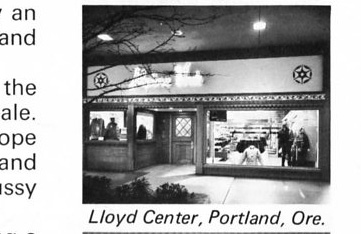 Their President was famed climber Dick McGowan (Richard E. McGowan,
1933-2007), who had previously been an REI Store manager. Famous
Himalayan climber Nicholas Clinch said of him, "He was a
pioneer businessman in the outdoor industry."
Their President was famed climber Dick McGowan (Richard E. McGowan,
1933-2007), who had previously been an REI Store manager. Famous
Himalayan climber Nicholas Clinch said of him, "He was a
pioneer businessman in the outdoor industry." 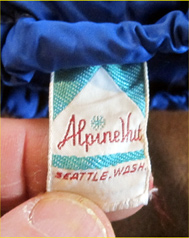 Other
important climbers of the day were also named as "Directors,"
eg. Pete Schoening, Lute Jerstad, and Paul Wiseman, among others....Oregon
had one of their stores, and it was located inside Oregon's first
indoor mall shopping center-- the Lloyd Center, on the near NE
side of Portland, just off I-84 freeway.
Other
important climbers of the day were also named as "Directors,"
eg. Pete Schoening, Lute Jerstad, and Paul Wiseman, among others....Oregon
had one of their stores, and it was located inside Oregon's first
indoor mall shopping center-- the Lloyd Center, on the near NE
side of Portland, just off I-84 freeway.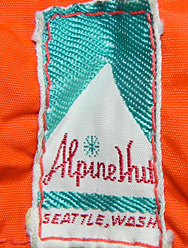 Any reader who knows more about this store, or when it closed,
please contact me. The label picture is compliments of Jim Scott,
who bought some down expedition mittens from them in 1966, in
preparation for some Alaskan climbing on Mt. Blackburn.
Any reader who knows more about this store, or when it closed,
please contact me. The label picture is compliments of Jim Scott,
who bought some down expedition mittens from them in 1966, in
preparation for some Alaskan climbing on Mt. Blackburn.
Note: Anderson's opening its doors in 1920 makes me wonder about a possible connection to Lloyd Anderson, who was very involved in the beginnings of REI Coop in Seattle 18 years later. If any readers have information, I'd appreciate hearing it. (contact me at brucej@oregonphotos.com)
A mountain shop dear to this writer's heart was Tri-Mountain Sports of Bend, Oregon, named for the nearby Three Sisters mountains.. It was founded in the early 1970s, quite a bit more recently than Anderson's or Cloud Cap, but was definitely worthy of spirit. It was a small shop in the historic part of downtown Bend-- small, but packed to the rafters with a diversity of the best brands of hiking, cross-country skiing, and backpacking gear! And the owner had periodic great sales! Click here for a reader contribution about Tri-Mountain.
Finally, let us not forget
Ed Johann's mountain store in Tigard, on Hall Blvd, just south
of the junction with Hwy 99W. Edward Johann was a survivor of
Pearl Harbor, and probably better known for his guiding as the
head of Johann's Mountain Guides Service, but his small mountain
store "Johann MT Shop" was begun in 1964 and moved to
its present quaint location in (I believe) 1976. 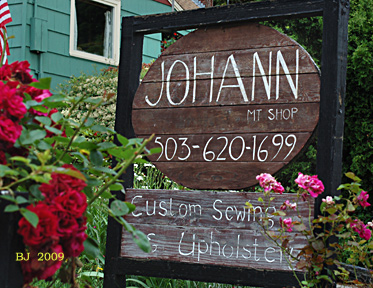 It's
beginning was two years before Frosltine Kits of Colorado got
started.... Johanns was tiny by REI standards, and specialized
in two things: mountain climbing equipment and doing repairs and
modifications to tents, packs, etc. Nowadays, Mr. Johann himself
is gone, but his son-in-law Gary Craghead carries on in the same
location with "Johann's - Custom Sewing, Prototyping &
Consulting Services." For readers of this page, the important
thing to remember is that if you need any type of repair or modification
of a piece of your climbing, hiking or backpacking gear, you should
give Mr. Craghead a call (ph 503-620-1699).
It's
beginning was two years before Frosltine Kits of Colorado got
started.... Johanns was tiny by REI standards, and specialized
in two things: mountain climbing equipment and doing repairs and
modifications to tents, packs, etc. Nowadays, Mr. Johann himself
is gone, but his son-in-law Gary Craghead carries on in the same
location with "Johann's - Custom Sewing, Prototyping &
Consulting Services." For readers of this page, the important
thing to remember is that if you need any type of repair or modification
of a piece of your climbing, hiking or backpacking gear, you should
give Mr. Craghead a call (ph 503-620-1699).

Later I will add pictures from my visit to Oregon Glove Company in Salem. I was shown around by their long-term General Manager Dean Catherman. I replaced my 6 year old, thornproof goatskin leather gloves with two new pair, and now am set for ten more years! www.oregonglove.com, in business since 1948, which was a mere one year after Holubar Mountaineering opened for business in 1947. These goatskin gloves make a very fine rapelling glove.
"Dear Bruce: Howell's was located just off 23rd & Burnside in west Portland, and it is where I bought my very first 'modern' pack--an Alpenlite framed pack with a Sierra-Design stitched bag attached to it--$62, in Spring 1972. Howell's carried North Face, Trailwise, Sierra Designs, Alpenlite & Jan Sport as their main gear brands. The first floor was set up with backpacking gear, sleeping bags, clothing, packs and stoves--what was great about Howell's was that the spacious top floor was covered end-to-end with set-up backpacking tents from all the main tentmakers--I still have memories of viewing the Trailwise Fitzroys, Sierra Designs Glacier & 3-man tents and the Jan Sport domes, as well as viewing a blue North Face VE-24--my first look at a new type of tent--the geodesic! Every model from each manufacturer covered that top floor--it was great for comparison! Not sure when Howell's closed down, but it was probably in the early 80s. FYI--- JK
"Another shop you ought to mention in your list of backpacking shops was Tri Mountain Sports here in Bend--Pat McKeown started up the shop in the early 70s and closed it down in the mid-90s--I know he went at least 25 years with the store because he had some water bottles made up with a 25 year logo imprinted on them. He sold top end gear--Sierra Designs, North Face, Kelty, Dana Designs, Gregory, Osprey, and had some great sales on end-of-season gear. Had a great XC ski gear inventory, & even carried pulk sleds for awhile. Great owner & guy to work with--started with a small spot on Wall Street in downtown Bend and later expanded it back towards the Mirror Pond parking lot--- JK."