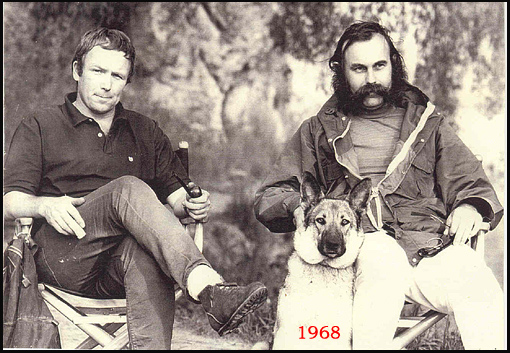
 Bob and George
Bob and George
Bob and GeorgeGEORGE MARKS (aka The Walrus) discovered my History of Gear project and soon sent me his own lovingly constructed history of his company, full of both Sierra Designs products and his remembrances and praises of those he worked with over the years. A little later, Co-founder Bob Swanson joined the conversation. In the years after that initial conversation, Bob joined some other conversations, such as a 2014 discussion about the history of the introduction of Cordura fabric to the industry. R.I.P. --Sadly, on October 16, 2016 Bob passed away at his home in Maine. George continued to live and work in southeastern China but finally passed away and was cremated August 6, 2023 (details forthcoming once I find an official obituary).
The Beginning: around 1963 George was working at George
Rudolph's Trailwise/Ski
Hut in Berkeley, California.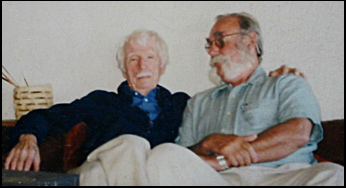 Soon a fellow named Bob moved into town with job references from
Holubar Mountaineering in Colorado...
Bob got hired on at Trailwise, and they became co-workers. Image:
George Rudolph on the left, with Mr. George Marks, his former
employee and long-time neighbor in Point Richmond, California....
This picture taken late in Mr. Rudolph's life. Image contributed
by Mr. Marks.
Soon a fellow named Bob moved into town with job references from
Holubar Mountaineering in Colorado...
Bob got hired on at Trailwise, and they became co-workers. Image:
George Rudolph on the left, with Mr. George Marks, his former
employee and long-time neighbor in Point Richmond, California....
This picture taken late in Mr. Rudolph's life. Image contributed
by Mr. Marks.
In 1965 Bob and George left Trailwise and set themselves up at 137 Tewksbury in Point Richmond as "Sierra Designs." Soon they were sewing day and night to create enough "product" to keep a roof over their heads. Times were tough for the next several years after their October 1965 official opening. Their very first catalog was produced the following spring and entitled the "66-67" catalog; George recalls that it was printed as a "very modest run of 2,000 copies." Their first and largest account was with The North Face retail store, for which they manufactured down items that were labelled "Made Expressly for North Face by Sierra Designs." (these are now rare and collectible since that contract only lasted a couple years, and was between two companies that were at the time still very small). Recently the famous fashion icon Tyra Banks' website has added some of the above material; to see this interesting development, click this link to her TypeF.com website.
Please Note: All Material below, and in all my "History of Gear" webpages, is copyrighted, and no usage of my material is permitted unless explicit permission is granted by me, Bruce B. Johnson, owner of OregonPhotos.com. Some of the material below is derived from interviews and/or correspondence with George Marks and Bob Swanson, co-founders of Sierra Designs. ....Readers: if you were involved with one of the old-line, vintage gear companies and have a story to tell in these pages, please contact me soon at brucej@oregonphotos.com
Within the History of Gear,
Sierra Designs had a Signature Product for which they became amazingly
famed. Interestingly,
it was not part of their initial line-up of products. Of course
we are speaking of the Sierra Designs 60/40 Parka, which
was introduced in 1968. To place this date within the History
of Gear,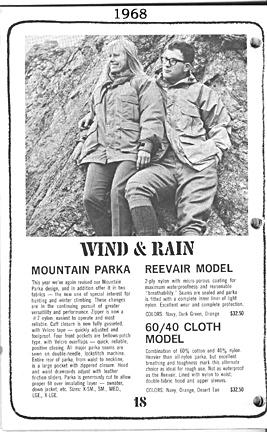 I will note that this is the year that one of Bob
Swanson's former employers, Alice
Holubar, died......
I will note that this is the year that one of Bob
Swanson's former employers, Alice
Holubar, died......
THE ORIGINS OF 60/40 CLOTH:
I interviewed Mr. Marks about their famed 60/40 parka and the "60/40" cloth that forms its essence. His reply about the merits of 60/40 cloth as a fabric was a bit tongue in cheek, "It was the cloth that made us famous." He also shared that really the fabric began as a 58x42 blend of cotton (the 58, the "warp") and nylon (the 42, the "weft"), and he just rounded the numbers off to 60x40 for convenience. John Murphy, back in the 70s the President of bigtime fabric supplier The Arthur Kahn Company, said that Harold Marks, former owner of TAKC, and his Sales Manager Thor Gustafson were the co-inventors of 60/40 cloth in 1972-73.
My younger brother had an orange SD 60/40 parka that he used in his work for the US Forest Service during the very early 70s. For some reason that I cannot remember, I never bought one for myself, but I was always stealing his. It went so well with my Pivetta boots as I stalked around campus as a real climber.... Looking back, I have a very postive "take" on 60/40 cloth and the famous shell garment into which it was made....Here is why--- First, one must place 60/40 cloth into the context of its times-- Goretex was still 8-10 years in the future when the 60/40 parka began to establish its near-cult following. The other shell parkas of the time used materials which had no clear superiority over this newcomer called 60/40 cloth. Sure Ventile cotton was great if sewn with care and precision; sure, the Holubar NP22 cloth was good, too. Reevair had its benefits as a pre-Goretex fabric that had some waterproofness but still breathed to some extent. And in the realm of shells that were designed to be waterproof there was no real competition. Waterproof shells of that era were designed using urethane-coated nylons, but were not as waterproof as what modern consumers have come to expect (remember that this was an era without any modern techniques of sealing garment seams, such as heat taping, etc.). The fact was that 60/40 cloth, in its day, was a great material. Additionally, it was durable, and possessed an ideal "hand" for its intended use ("hand" refers to a somewhat subjective measurement of how the fabric "feels" to the hand and body of the wearer). 60/40 felt like a strong mountain shell, but also had a soft feel that draped well and was not harsh or noisy as one moved in it. Sure, it leaked if the rain was heavy but one could always put a new coat of silicone spray on it. And of course it had an advantage over Goretex-type materials in that a rugged outdoor person could get it plenty dirty and it did not affect its performance! Very recently, the modern Sierra Designs company has introduced the 60/40 parka once again, calling their version "The 60/40 Short Parka," please click this link to their website (SierraDesigns.com), where it can be purchased!
HISTORY OF GEAR BOOK SERIES--- I have written ten books as of 2020, five of them specifically about the History of Gear. Click here to see more about the ten of them: Bruce ten books. ...... My book about Holubar was honored in May 2010 as among the best of 2009's "Local History" books. This event was held at the Chautauqua in Boulder, Colorado. I traveled to Boulder in June, 2011, giving presentations about the big three that originated in Boulder (Holubar, GERRY, and Frostline Kits).
George Marks has not had a role with Sierra Designs since he departed in October of 1984, just under twenty years from when he and Bob Swanson began the company.. Bob had left previously and had established WALRUS TENTS, which George joined. In recent years, the good news is that Mr. Marks' endeavors are still in the area of outdoor gear production. In support of those endeavors, he has lived in China for many years and is Managing Director of a company there. Dec. 2023; Mr. Marks has passed away; exact date unknown.
Mr. Swanson is also no longer part of Sierra Designs and lives in the Northeast United States. Bob and George remain fast friends. Click here for a picture of Mr. Marks in 2007. You will see him with an old friend and fellow gear pioneer from JanSport named Skip Yowell. Mr. Swanson has passed away more than a year ago.
The modern SD company is teamed up with Kelty and a couple other brands such as Slumberjack. It does considerable overseas production in China and Korea, with an official U.S. headquarters location in Louisville, Colorado, and a Canadian headquarters in Brampton, Ontario, plus assorted other "partner" locations worldwide. Recently, they have brought back a special, "Heritage" edition of the original 60/40 parka; I have one, and it is very true to the original and very nicely done.
