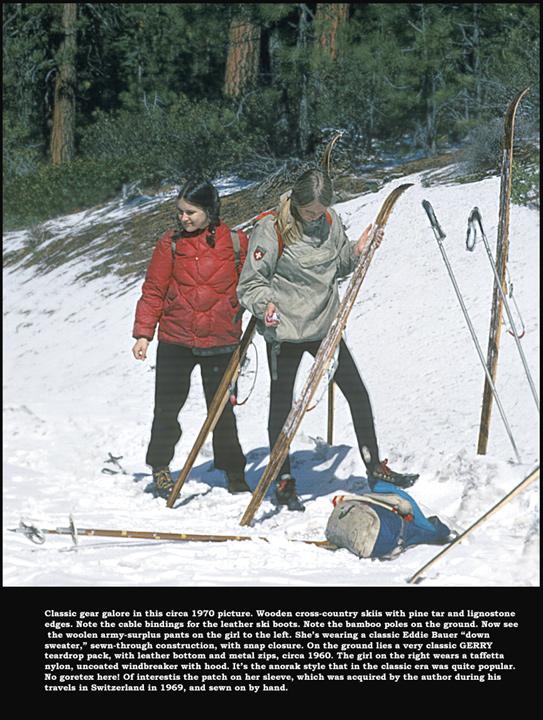
Class gear galore is seen above, in this circa 1970 picture from the Central Oregon Cascades. Wooden cross-country skiis with pine tar, waxed bases and lignostone edges. The girl on the right holds a tin of Swix brand wax in her hand, "Swix Purple" I believe, which in 1970 cost 50 cents a tin, but in 2010 costs about $5 per tin, in the rare places you can even find it. On the skiis are brand names hailing from Scandanavia, and not just advertising lies, either, these actually made and imported from Scandanavia. Note the bamboo poles on the ground. Now see the woolen army-surplus pants on the girl to the left. She is also wearing a classic Eddie Bauer "down sweater," a sewn-through quilted construction with snap closure. And under the down sweater, just visible, is a classic Pendleton wool shirt... On the ground lies a very classic GERRY teardrop pack, with leather bottom and metal zips, circa 1962 (and worth a lot of money on eBay these days!)... The girl on the right wears a nylon, uncoated windbreaker with hood. It's the anorak style garment that in the classic era was quite popular. There is no Goretex to be seen in this picture, it's still about 15 years in the future! Of interest on the gray anorak is the shoulder patch, which was acquired by the author during his travels in Switzerland in 1969, and sewn on by hand.
In the picture below we see my old Opel Kadet station wagon,
half-buried with snow on a supposedly "Spring" overnight
trip into the Diamond Peak Wilderness of the Central Cascades
in 1970 or '71...... Starting on the left side of the picture,
there is a classic "climbers rucksack" with leather
bottom by Alp Sport, which
on eBay today could easily bring $200 if in good condition. Attached
to that pack is a wooden-shafted ice axe by Grivel (see
section on classic ice axes below).... The large green frame pack
is a true Classic pack, a Kelty
BB5 with extension bar. Attached to that pack is a very
early MSR Thunderbird metal ice
axe. For sleeping "comfort," there's a pathetic piece
of full-lengh 3/8 inch thick Ensolite. The young woman
is wearing a French-made, fully-baffled down expedition parka,
the Lionel Terray model "Jamet." She's wearing
army-surplus whipcord pants and leather 3-pin ski boots. In the
background are bamboo cross-country ski poles. 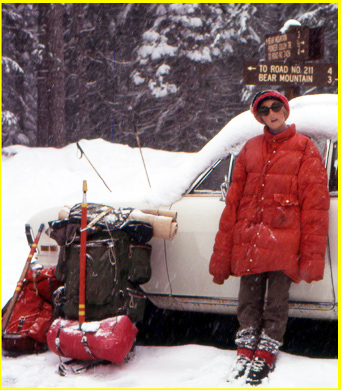 (perhaps
the down parka was by 1970 being made for Terray by Montcler,
in Clermont, France)
(perhaps
the down parka was by 1970 being made for Terray by Montcler,
in Clermont, France)
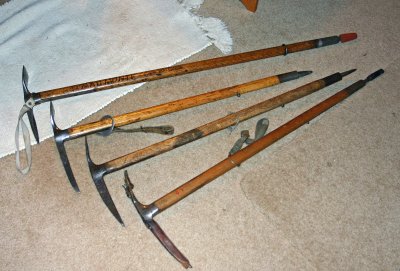
Below are four classic era, wooden-shafted ice axes; I think one of them is by Stubai of Austria.. Notice, there is no aluminum, and notice that very long shaft lengths, modern short shafted axes being unknown in the early era. Often the heads were attached with copper rivets. Such old axes in good condition are now bringing premium prices on eBay, well over $100, and in some cases much, much more, eg. for a very old one made by a lengendary Swiss blacksmith.. Picture compliments Monte Dodge, a frequent contributor and big Pacific Crest Trail through-hiker. For a related page, visit my history of MSR page (Mountain Safety Research).
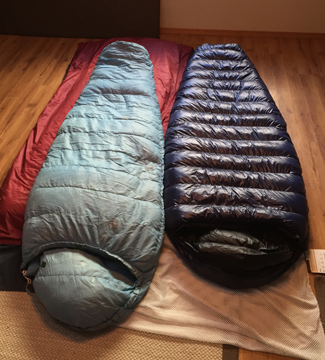
Above we see the history of ultralight down sleeping bags illustrated. On the left is a circa 1968 Sierra Designs "Superlight" bag, and on the right a 2015 Western Mountaineering* bag the "Terralite." The vintage 1968 Superlight achieves its 2 lb. 12 oz. weight by using a very slim cut, a 1.5 oz. ripstop shell, and only the best Northern European down (fillpower not given but estimated 600-650); it had a temperature rating of about 15-20 degrees..... The 2015 Western Mountaineering bag weighs just 1 lb. 13 oz. and represents the incredible advancements we've made in bag materials and design. The Terralite uses exotic ultralight nylon fabrics** and insanely good 850+ fillpower down, which allow it to have a roomy cut without losing the ability to compress to a tiny 7x13" size for packing. The Terralite's temperature rating is 25 degrees. (* WM founded in 1970 in San Jose, California, not far from the then-location of then five-year old Sierra Designs!) ((** 12 denier ripstop for the shell fabric and 15 denier taffeta for the lining))

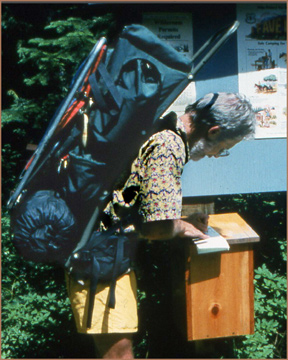
Obviously, the person on the left models comfort, ultralight style! Gone is the heavy, durable backpack, even packs like Rivendell Jensen packs are considered too heavy, ditched in favor of thin, stripped-down 16 oz. creations using more modern fabrics. Many credit the modern rise of the Ultralight backpacking movement to Ray Jardine, by his example and his seminal books, especially his "Beyond Backpacking" in 1999.
I wonder if these ultralight packs will still be carrying loads 30-40 years from now. Can they possibly be as long-lastingly durable as the bombproof packs of yesteryear? Also made obsolete are many, many other items of clothing and equipment, replaced by Titanium cups and cookpots and tent stakes, little bitty stoves made in some cases out of pop cans burning alcohol; big heavy leather boots replaced by nylon low-cut "trail shoes" not much more substantial than the typical jogging shoe. For sleeping, the new breed have replaced their comfy, high-tech Thermarest full-length pad with a thin 2/3's length slab of narrow dense foam that weighs mere ozs. . The sleeping bag is still filled with down, but its fit is tight and its temperature rating is absolutely not one degree more than what summer camping demands....And TENTS, OMG, this "tent" above weighs 1/6th what my sturdy old Snowlion A-frame weighed. There are miracle lightweight tent fabrics like Soar-Coat, sil-nylon, spinnaker fabric, Dyneema, and the latest, Cubic Technology's CT3 (Cuben Technologies); in some applications, even traditional sewing has been replaced with "bonded" seams, leading to new taglines calling the next wave of gear the "SUL," or Super-Ultralight revolution!
.... What's been lost, well, in the lightest designs of shelters, a floor has been lost, and really the tent is just a sophisticated tarp. Bugs and snakes and critters can crawl under the edge and get you--- Mosquito and black fly protection is far from complete, and there are no tent poles, she just uses one of her hiking poles. And in the clothing department, so much has been left behind that there's no substantial down jacket or thick gloves in case one of those protracted summer snow storms comes in off the Gulf of Alaska, such as the one that pinned-down and killed up at Chambers Lakes on the glaciated high divide between South and Middle Sister..... And in the trip documentation department, the ultralight trips won't be recorded on a heavy metal 35mm camera with 2 or 3 auxiliary lenses, instead a tiny digital camera not much larger than a pack of cigarettes will have to do. What is the Balance Sheet on the Old vs. the New? We'll leave that up to the reader to decide, but what is clear is that older backpackers with troubled joints and lessened muscle mass are truly put back on the trail again by shedding so many pounds of gear! .
I personally want to applaud the many American innovators who are recapturing the Spirit of the early days of Classic Gear. Many of them work in small operations run out of garages and outbuildings, with a staff of just a few committed, excited people, beginning with big dreams, slim wallets and prayers, just like so many of the Classic companies that I write about in this HISTORY OF GEAR website. Bravo!
GERRY Mountain Sports, founded in 1946, was the first company with a major commitment to ultralight gear and its principles.
Warmlite (Stephenson's Warmlite) began producing innovative, super light gear in the early 1960s and are still in business today. Their tents are extremely light, extremely strong, and are full-featured four-season tents with floors, mosquito-proofing, and more. They've been using advanced superlight fabrics with advanced coatings since at least 1980, and moved into using Soar-Coat in 1994 (a cousin of sil-nylon).
HikeLight.com, a Portland area resource of major proportions. Its owner has been very helpful to me. They pride themselves for relentlessly researching the lightest possible options for each and every piece of gear you might dream of carrying on your trip. They offer a free E-Book about ultralight gear and packing that is very complete.... (nano dyneema spectra cord, plastazote foam pad, spectra aircore, cuben fiber, spectra guylines, no-sew seams, tarp tents with impregnated tieouts).
Please Note: All Material on this page, and in all my "History of Gear" webpages, is copyrighted, and no usage of my material is permitted unless explicit permission is granted by me, Bruce B. Johnson, owner of OregonPhotos.com. . Editors: Please contact me if you have interest in publishing Contact: brucej@Oregonphotos.com --Others: if you were involved with one of the old-line, vintage gear companies and have a story to tell in these pages, please contact me soon. Sponsors: the History of Gear Project is soliciting a few quality sponsors to support its continued research and publication efforts.
BOOK ALERTS: MY FIRST BOOK IN A SERIES ABOUT THE HISTORY OF GEAR WAS ABOUT FROSTLINE KITS. PLEASE VISIT MY FROSTLINE PAGE FOR A LINK TO ORDER IT, IN EITHER SOFT-BOUND OR HARD BOUND EDITIONS... The second book was released May 20, 2008 and is titled, "GERRY, To Live in the Mountains" (click on GERRY link below). The third book of the series covers the story of Holubar and was recently honored as one of the year's best "Local History" books at Chautauqua in Boulder, Colorado.... All three books feature major contributions from their founders or their Presidents. More recently, I have released my fourth book, "MSR, Defying Tradition," detailing the early days of MSR under its often controversial leader Larry Penberthy. And more recently, I released "Warmlite, Still Controversial After All These Years," in a commemorative 110 page edition after founder Jack Stephenson passed away in early 2017.
