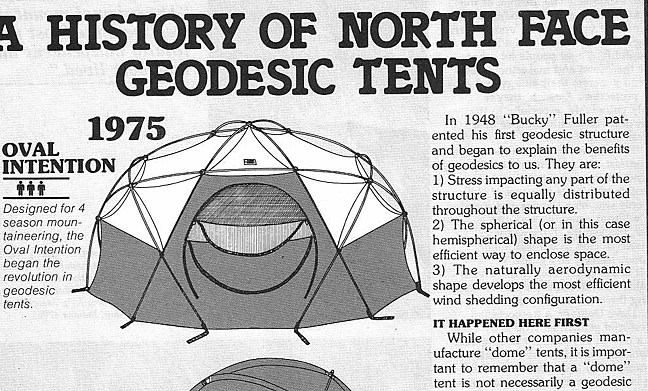

Within the overall History of Outdoor Gear, I like to think of the period 1945 to circa 1980 as representing a sort of "Golden Age" because so many small companies and individual innovators were making their marks during this time frame and using many new materials. I will begin with the creation of the World's first modern geodesic backpacking tent, 1975-76.
Geodesic tent pioneers: R. Buckminister Fuller, Robert "Bob" Gillis, Bob Howe, and staff at The North Face, especially Mark Erickson and Bruce Hamilton. Who was "first" with a backpacking geodesic tent is somewhat murky, Gillis is there for sure, but in terms of bringing the final working geodesic tent to market I would give the nod to Erickson and Hamilton (more on this topic below). And Bob Howe was very close behind.
World's first geodesic backpacking tent, introduced 1975.
Subtext: major advances in tent pole technology by Easton Company were an essential design ingredient necessary to bring the Oval Intention to market as a back-packable tent. This led to a dazzling new age of domes, geodesic and tensioned fabric designs that were to take over the world of tent design. Link to material about 2018 tent pole company with Easton heritage.
Backstory: in the same timeframe, another tent designer had teamed up with another major company and were about to introduce their own geodesic tent, but things fell apart at the last minute.. Click here to skip to that story about Snowlion and equipment designer Bob Howe.
Buckminister
Fuller (1895-1983): the US postage stamp shown above does not
picture Bob Gillis! Across the top of the stamp, you see "R.
Buckminster Fuller." His nickname was "Bucky," and
many regard him as the forerunner of the whole geodesic tent revolution.
He is undoubtably the person who made the United States' first
geodesic tents, and even sold some to the US Army in the 1950s.
In the 1950s Bucky's huge permanent geodesic domes made him famous.
On the stamp, notice the domes, especialy the geodesic design
planted on the hemisphere that is Bucky's head! By the mid-70s,
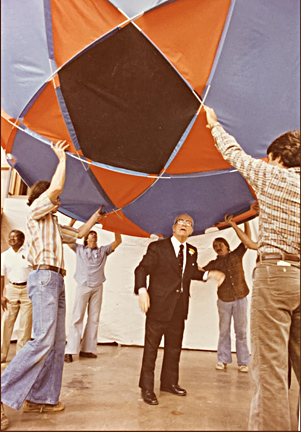 Bucky
is seen in pictures hanging out with North Face staff, where he
was a fondly welcomed adviser. In the picture, North Face staff
including Bruce Hamilton are having fun showing off a giant geodesic
prototype they have created.... I have a scanned copy of a letter
Bucky sent Bob Gillis on Nov. 8, 1974. For much more on "Bucky"
(Buckminster) Fuller (1895-1983) simply go and look him up on
Wikipedia.
Bucky
is seen in pictures hanging out with North Face staff, where he
was a fondly welcomed adviser. In the picture, North Face staff
including Bruce Hamilton are having fun showing off a giant geodesic
prototype they have created.... I have a scanned copy of a letter
Bucky sent Bob Gillis on Nov. 8, 1974. For much more on "Bucky"
(Buckminster) Fuller (1895-1983) simply go and look him up on
Wikipedia.
Bob Gillis does figure prominently in terms of a modern backpackable geodesic that made it to the retail market. He says that he showed up at North Face one day after a trip to Colorado wherein someone at GERRY advised him to take his design to the North Face. He says he met with owner Hap Klopp to present a geodesic tent concept. In the decades since then, Gillis has offered "tensegrity" shelters of various designs, up to over 30 ft. in diameter, most using plastic tubing and his patented "grip-clips" as the framework. However, mostly he has not offered products for the backpacking/mountaineering tent market.
Gillis' involvement with North Face designers led directly to the introduction of a stunning new tent based on geodesics! The historic tent was the "OI," the World's first successfully commercialized geodesic dome tent that was made of modern backpacking materials-- lightweight aluminum poles and lightweight nylon fabrics.... "OI" stands for "Oval Intention," a delightful name which seems to incorporate wordplay, eg. "In-tent-" and "intention," as in a designer's "intention" to revolution the tent design industry! Click here to skip to a picture of one of Gillis' giant-sized, modern geodesic domes (a 20 foot diameter dome manufactured in 1998). Below, here's a picture, date unknown, showing a bunch of geodesic design models, Gillis is on the left. On the right is Sierra Designs co-founder Bob Swanson (deceased, October 2016). (click). Sierra Designs as a company, were somewhat late in getting into marketing geodesic tents. But once they got in, they produced such wonderful geodesics as my early 90s TIROS tent. Gillis says he was quite involved with Bob Swanson's Walrus Tents company after Swanson left Sierra Designs.
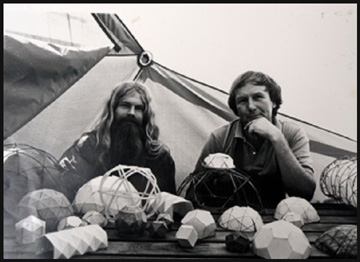
Bob Gillis says he is the holder of many patents regarding design of various "tensegrity" structures. His website contains a long page that is quite technical about his various patents; the detail is beyond my layman's capacity to evaluate! At various times, he was involved with North Face, Sierra Designs and Bob Swanson's Walrus Tents. The North Face "Oval" capitalized upon the untoward strength of a geodesic design, and was marketed as an exceptionally sturdy 4-season mountaineering tent. Bob Gillis states that he licensed the tent to The North Face (TNF), although North Face catalog materials do not mention him. North Face brought the tent to market in 1975. In creating a backpackable tent, North Face worked with Jim Easton of Easton Aluminum Company to modify arrow shafts into the first thin, flexible aluminum tent poles, essential to the structure of the Oval Intention....This particular tent and its design are so central to the later developments in backpacking and climbing shelters that I have included a high resolution copy of a North Face catalog advertising the Oval Intention. See Below.
In 1976 Gillis began "Shelter Systems Company," the year after TNF began to sell the Oval Intention..... I am pleased to report that in 2021 Shelter Systems is still a company building innovative (geodesic?) and "tensegrity" portable domes and shelters in many sizes and variations. Various Shelter System shelters and other products have become central in disaster relief programs worldwide. Many use plastic tubing for the frames, with "grip clips" holding the inner tents, which are made of various types of plastic sheeting, often the heavy, reinforced types seen in the temporary structures put up at county fairs and the like.
Bob Gillis posts a very interesting and useful history of himself and his company. He is an innovator who actually has spent much of his adult life living in various domes/structures of his own creation-- Gillis reports that he went to JanSport, GERRY and other Colorado companies circa 1975 and was advised to take his backpackable dome prototype to TNF by someone at GERRY. That event, and much more is detailed, including his later work with Bob Swanson, co-founder of Sierra Designs and founder of Walrus... Go to this link (2021): http://www.shelter-systems.com
Link to Shelter Systems website, showing what Bob Gillis names as the original Oval Intention tent, page one, and displays the Award-winning final design which he states that he licensed to the North Face. On this page Gillis offers an extensive history/description of his often novel designs and mentions his collaborations and attempts to collaborate with numerous companies and industry pioneers such as Bob Swanson of Sierra Designs/Walrus Tents (click)..
Grip-Glips: Gillis states that he is also the holder of the patents for the now widely-used "Grip-Clip," which he states was similarly licensed, this time to North Face's long-time competitor Sierra Designs (I have not researched this patent claim). There is some debate in the industry about these matters. The Sierra Design "Swift Clips" have been in very successful use for many years now...... Below is a picture of Bob Gillis circa 1984:
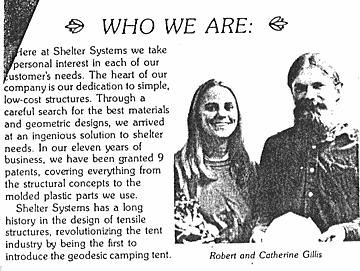
http:www.YurtDomes.com http:www.GripClips.com
http:www.ReliefTents.com, and Shelter
Systems main website.
Another tent backstory: Who the heck gets the credit for the FIRST DOME TENT (non-geodesic)? Click for information about this fascinating topic.
HISTORY OF GEAR BOOK ALERTS: My first gear book was "Frostline Kits of Colorado" (click). The second book in the series was released May 2008 and is titled, "GERRY, To Live in the Mountains" (click). The third book is "Holubar Mountaineering Ltd." (click). It was honored as one of the year's best "Local History" books at Chautauqua in Boulder, Colorado in 2010.... All three books feature major contributions from their founders or their Presidents. You will be able to order either from my Publisher, or directly from me as an inexpensive PDF download for $15 per book..... I am a verified PayPal seller. My fourth book is about the oft-controversial early years of MSR, under the leadership of its founder Larry Penberthy, please inquire. A fifth book, my longest, takes a deep dive into the ground-breaking innovations of Stephenson's Warmlite Equipment Co. Here is a link to an overview page of my books:
I personally owned one of the first Oval Intention tents, buying mine in 1976. It was the vintage, original model, called the "Ring Oval," so-named because its poles were placed through small metal rings at each intersection (see drawing above); later the "ring Oval" was replaced by the "Pole Sleeve Oval," where the poles travelled through sleeves of nylon fabric, a design favored by TNF (The North Face Company) in its evolving line of geodesics such as the "VE-24" (1978) and the big "North Star" dome (1979). For many years now, geodesic mountaineering tents have been favored by major expeditions, and have sterling reputations for great strength during high winds and with high snow-loading; however, one of the strongest tents ever made was a diminutive modified A-frame called the Rivendell "Bombshelter" (click for more info)..
Click here to see an even larger geodesic tent, this one made for expeditionary use by Mountain Hardwear, and a full 6 meters in diameter!
Below is an exciting image, showing that geodesic pioneering is still alive and well in the World. This image was sent to me in 2008 by a fellow named Thomas Holden, who runs an East African tour company, in Tanzania, naturediscovery.com ..... He has designed for his company some geodesic, single-walled tents! The one shown below is 4 meters in diameter. It's shown enduring violent winds at "Crater Camp," which is at 19,000 feet, just below the highest point of Africa, "Kibo," on Mt. Kilimanjaro! The ice wall in the background is bigger than it looks, and is the enduring, but receding, remanant of the large glaciers which extended far down Kilimanjaro during the last Ice Age, and were still covering about 20 sz. kilometers as recently as 1912. The current glacial size is a depressing 2.6 sz. kilometers, which is a loss of 87% in the last 95 years.

Memories:
My "Oval" had an interior that I especially loved---
spacious, with very warm, tasteful use of the colors tan, yellow
and blue. Even on dull, cold days, the light spectrum filtering
inside made one feel sure that it was sunny outside....It was
a very pleasant tent to be inside, and yet it was also an extremely
strong and secure tent in which to sit out a big snow or windstorm. I remember well a
big storm above timberline on Mt. Shasta where friends nearby
in A-frame design mountaineering tents spent a nerve-wracked night
full of fears that their noisy, flapping, cracking tents were
about to self-destruct, while my Oval Intention was like a bomb
shelter-- when extra-heavy gusts hit it, all it would do was "creak"
a little as it seemed to settle lower into the ground and distribute
the stress all over its outer skin. Alas, I no longer have it---
I sold it because of its large packed size and 11 pound weight,
a bit too much for me since I was using it mainly as a two-man
mountain tent. Pictured to the left is a 1979 vintage pole sleeve
Oval like mine, picture compliments of Deems, a PCT thru-hiker
of renown.
I remember well a
big storm above timberline on Mt. Shasta where friends nearby
in A-frame design mountaineering tents spent a nerve-wracked night
full of fears that their noisy, flapping, cracking tents were
about to self-destruct, while my Oval Intention was like a bomb
shelter-- when extra-heavy gusts hit it, all it would do was "creak"
a little as it seemed to settle lower into the ground and distribute
the stress all over its outer skin. Alas, I no longer have it---
I sold it because of its large packed size and 11 pound weight,
a bit too much for me since I was using it mainly as a two-man
mountain tent. Pictured to the left is a 1979 vintage pole sleeve
Oval like mine, picture compliments of Deems, a PCT thru-hiker
of renown.
TENT POLES: Where to go when one of these beautiful poles breaks or needs other repairs? If it's a North Face tent, NF warranty department may be your best resource, but for all others, and for custom pole designs, you cannot get more expert help than from ex-Easton pole guru Tom Hegerle at TentPole Technologies LLC.
Notes about the image below-- the reddish-orange tent in this 1977 image is a top-quality expeditionary A-frame called the REI Denali Expedition, as evidenced by its rear vestibule/tunnel entrance area and zippered cookhole in the floor (the Denali was similar to the Glacier made by Sierra Designs and also to an REI stablemate called the Crestline); it required a veritable forest of stakes in high wind conditions, but even with lots of staking was not very quiet or reassuring in severe winds; also, it was not particularly lightweight..... Visible on the left is a North Face Dandelion tent. This was a spacious NF tent, not a geodesic, although it did utilize the exact same colors as the Oval Intention which I had owned a year or two before.... Regarding the Dandelion, its designer Mark Erickson told me this story, "....At the time, we joked that the tent was so named because it was "dandy lyin' in it." A large capacity Kelty "BB5" frame pack pokes up over the edge of the Dandelion.

Please Note: All Material above, and in all my "History of Gear" webpages, is copyrighted, and no usage of my material is permitted unless explicit permission is granted by me, Bruce B. Johnson, owner of OregonPhotos.com
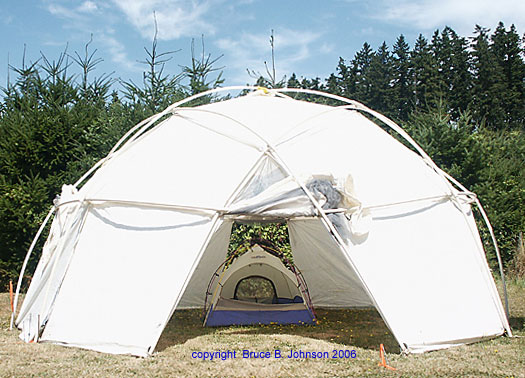
This 315 sz. foot white dome has seen
hard duty at the Oregon Star Party,
where strong winds, powerful sun, and lots of dust have aged it.
But the design lends itself to easy maintenance and repairs. For
scale (and for FUN), I set up my Sierra Designs "Tiros"
geodesic tent inside of the Gillis dome. In fact, this arrangement
makes a fabulous base camp. In effect, one has created a bright,
dry greenhouse in which to camp, each morning emerging to a dry
camp with no bugs! Incidentally, influential, long-time tent designer
Bob Howe rates the 7 lb. Tiros as one of the few tents he'd carry
for use in such snowy, wind-blasted places as Mt. Everest (click
to view pages about Bob Howe's many
contributions to the industry. This also leads to a page about
the Tiros in particular)
In fact, this arrangement
makes a fabulous base camp. In effect, one has created a bright,
dry greenhouse in which to camp, each morning emerging to a dry
camp with no bugs! Incidentally, influential, long-time tent designer
Bob Howe rates the 7 lb. Tiros as one of the few tents he'd carry
for use in such snowy, wind-blasted places as Mt. Everest (click
to view pages about Bob Howe's many
contributions to the industry. This also leads to a page about
the Tiros in particular)
Please Note: All Material above, and in all my "History
of Gear" webpages, is copyrighted, and no usage of my material
is permitted unless explicit permission is granted by me, Bruce
B. Johnson, owner of OregonPhotos.com. Some of the material above
is derived from interviews and correspondence with Bob Gillis,
Bob Howe, Mark Erickson, Alan Tabor, Bob Woodward, and others
not named, as well as my own research..... Editors:
Please contact
me if you have interest
in publishing....Others: if you were involved with one of
the old-line, vintage gear companies and have a story to tell
in these pages, please contact
me soon at oldgear@oregonphotos.com
