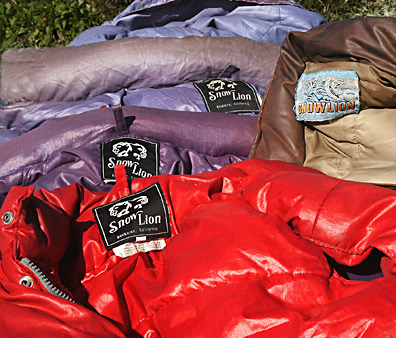
Snowlion! For a time in the early 1970s this Bay Area gear company was HOT, highly-respected and very innovative.
The early-mid-70s is when the red and blue down garments on the left were made. They all have standard 1.9 oz. ripstop nylon fabric. All were well-designed and well-sewn.
The brown jacket; however, is of uncertain provenance. It's a bomber style jacket filled with down and with a leather shell. It sports the exact label that formed the beautiful cover of the final Snowlion catalog (1978, see text below). This jacket is probably one of the final Snowlion products; however, it cannot be found in the Company's final two catalogs. A detail on the coat which is confusing is its metal snap buttons marked "EB," which could lead to a theory that this was a product sewn by Snowlion for Eddie Bauer.... I found this particular coat in about 1983, in a Eugene, Oregon close-out store that specialized in new, better quality, better brand name outdoor garments.
Please Note: All Material on this page, and in all my "History of Gear" webpages, is copyrighted, and no usage of my material is permitted unless explicit permission is granted by me, Bruce B. Johnson, owner of OregonPhotos.com -- Contact me: oldgear@Oregonphotos.com
....An interesting sidelight to
the company's name is that originally it was "Snowline,"
but it turned out that Eddie Bauer had a problem with
that since he already had products (a line of sleeping bags?)
with the "Snowline" name. A "Cease and Desist"
order came down. The Company's catalog designer Alan LaPointe
remembers, "I was charged with the challenge of quickly coming
up with a new corporate name. After days of brainstorming I came
up with "Snowlion." It sure sounded the same which helped
a little in the awkward transition. But it also opened up new
graphic possibilities which I worked on and eventually designed
the company's familar double-cat-head design logo and logo type.
We used the logo on everything: product labels, magazine ads,
stationary, catalogs, banners, convention display booth graphics,
etc." Thus the founders of "Snowlion" chose a sound-alike
name and were able to keep the customer base that they had begun
to build.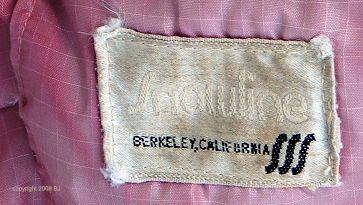 The
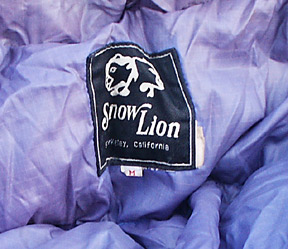
"Snowline" label shown is from a beautifully-made down
mummy bag, and thus likely was one of the newly-formed company's
first products, dating from the very early 1970s.
The
"Snowline" label shown is from a beautifully-made down
mummy bag, and thus likely was one of the newly-formed company's
first products, dating from the very early 1970s.
Snowlion, according to a long-term
ex-employee, was co-founded by Barry Soloway, Bob Shotland, and
Bill Simon (born circa 1947). Snowlion Corporation was based in
Berkeley, California...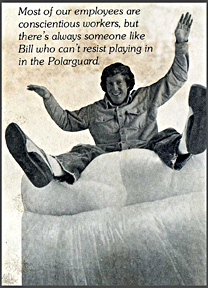 .After Snowlion was dissolved
in the later 1970s, Mr. Simon went to Asia (Hong Kong) and actually
became one of the persons responsible for the mighty move into
off-shore production that has taken over in the backpacking industry
(image: Bill Simon on a big roll of Polarguard, from company's
1976 catalog)... In the later 1980s, Mr. Simon became the owner
or President of both North Face and Sierra Designs (who were then
owned by a huge corporation named Odyssey Holdings, Inc.
"OHI", based in Hong Kong, founded by Bill Simon and
with him owning the majority share of the corporation).
.After Snowlion was dissolved
in the later 1970s, Mr. Simon went to Asia (Hong Kong) and actually
became one of the persons responsible for the mighty move into
off-shore production that has taken over in the backpacking industry
(image: Bill Simon on a big roll of Polarguard, from company's
1976 catalog)... In the later 1980s, Mr. Simon became the owner
or President of both North Face and Sierra Designs (who were then
owned by a huge corporation named Odyssey Holdings, Inc.
"OHI", based in Hong Kong, founded by Bill Simon and
with him owning the majority share of the corporation).
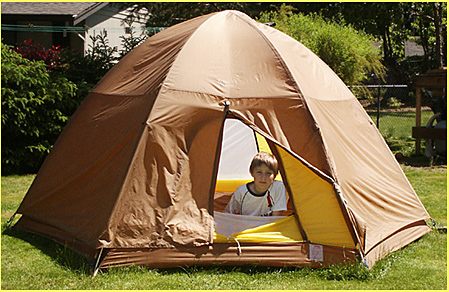
Snowlion sleeping bags bragged about solving the "cold spot over the zipper" syndrome via an insulative "double zipper" system that eliminated the traditional "draft tube" behind the zipper solution...... Snowlion's William N. Simon, filed for the patent on the double zipper for sleeping bags on 2/10/1975, and still holds that patent. The Company went bust and closed its doors unexpectedly in 1977 (last catalog was stamped as a 1978 catalog, click to see picture of this catalog cover), making it, in the History of Gear, one of the shorter-lived companies.... Also, click here to see a picture of the 1978 catalog cover, which is a rare and highly collectible item).......Then we have this real mystery--- a correspondent recently sent me a nicely-made yellow and brown "Snow Lion" tent. But the tags on it said "Made in Japan" (rather than Berkeley, California). Also, the logo on the tent body was "wrong," the words said "Snow Lion," but none of the other classic logo elements were there, and the brand was stamped onto the fabric rather than being a sewn-on label. Readers with any ideas about this should contact me. Go to page bottom for pictures of this mysterious label and the tent itself.
"AFTER SNOWLION CAME SNOWLION AGAIN." My catalog collection also contains what at first appears to be an inexplicable anomaly, a 1979 Snowlion catalog. But, didn't you just say the company went bankrupt and was gone? Yes, I did. This attempt by others to revive the Snowlion brand carried the name "Snowlion Mountaineering Ltd." It was very short-lived, and based in Kentfield and Emeryville, California. Offered in that 17 page catalog was an innovative departure from A-frame tent design, the Dewdrop, which was again a product of Bob Howe's fertile mind (see next paragraph).
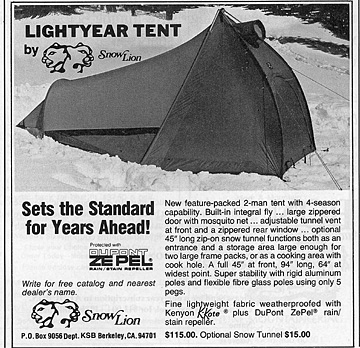
SNOWLION TENTS: In addition to its innovative line of down garments, Snowlion also manufactured its own line of mountain tents. Their tents were highly regarded. The flagship models, were geodesic domes designed by Bob Howe, but they never actually made it to the open market due to the bankruptcy.....Note that there is a picture of a mystery Snowlion tent at page bottom:
The Lightyear Tent pictured was one of Snowlion's final tent designs, designed by Mark Joseph (the Lightyear does not appear in my 1976 catalog). Snowlion was, as usual, innovating and experimenting, this time away from their line of excellent traditional A-framed mountain tents. The Lightyear combined straight, rigid poles with flexible ones. Scan courtesy of Monte Dodge.
SPECIAL NOTE: of very special note is this fact-- within the History of Gear, Snowlion had the sad distinction of "almost" being the second company to launch geodesic backpacking tents into the mainstream. For more on the story, please click here.
What is the human attraction
to, and love of such high-quality
backpacking and climbing gear? Somehow the motivations seem different
than those of collecting coins or powerful cars... To me, the
attraction of such camping gear is primitive, it's the caveman
in us, obsessed with shelter, warm furs, and roaring fire to fight
the harsh mountain night. It's a hairy, unshaven guy and his mate
always thinking winter thoughts in an Ice Age world... The gear
is a tool to preserve our lives and our independence under harsh
adversity..... I think about the outdoorsman's love of backpacking
stoves, and I suspect that there's something strongly connnected
to primal FIRE in that love.....For a fascinating, nostalgic look
at dozens of vintage camping stoves and lanterns, please see link
at page bottom for Monte Dodge's Stoves
and Lanterns....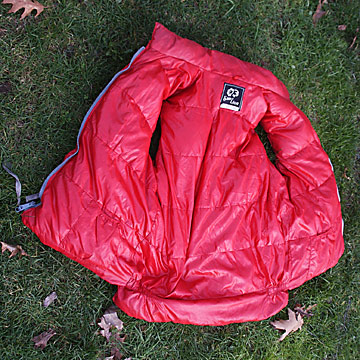
Snowlion, Berkeley, California, circa 1970s
A Snowlion "Bering" down vest! A vest so warm and comfortable that you can't believe that only a few were made and there's NO ONE making them in the 21st. Century! Fully-baffled, no sewn-through seams at all; a butt-warming extension, inner pockets to keep your lip balm or film from freezing, a two way zipper, puffy, heavily insulated outside pockets that hold cargo AND provide fabulous hand-warming spots. A fully-insulated draft flap to keep out drafts, and with snaps in case your zipper ever breaks during an expedition to the Karakoram!....
Please Note: All Material on this page, and in all my "History of Gear" webpages, is copyrighted, and no usage of my material is permitted unless explicit permission is granted by me, Bruce B. Johnson, owner of OregonPhotos.com

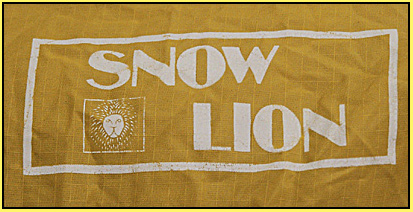
See tent picture below--- This Mystery "Snow Lion" Dome Tent has these specs: canopy is of a fairly porous 1.9 oz. ripstop nylon. This tent was donated to the History of Gear project by CJ in New Mexico. The Poles are heavy-duty fiberglass, and are not connected by any shock cord. There are three equal-length poles threading into sleeves, so in set-up this part is easy, but the lack of shock cords introduces a bit of trickiness into the set-up.... There are 24 fiberglass pole segments in total, each section is 26.5 inches long. There are also two shorter, thinner metal poles that are meant to prop the rainfly further away from the tent canopy. The total pole set weighs in at a hefty 4.3 pounds! The weight of the tent body and poles is 10.75 pounds, and this excludes rainfly and pegs. Tent has an interior peak height of a generous 66 inches, and floor is about 113 inches across, and is the same on all sides, thus giving this tent plenty of room for 3 adults, and 4 would fit in a pinch.... The design has only 3 poles and is self-supporting, but is certainly not a geodesic. I would call it a three-season design, great for car-camping or backyard fun, but not suited for severe winter or expedition conditions-- paradoxically, however, the tent is equipped with a cookhole, and what appears to be attachment points for a frostliner! There is also a large, but non-opening, rear window with netting for ventilation. All images copyrighted 2008 by Bruce B. Johnson