Sources
for outdoor fabric, down, and kits now that Frostline is Gone
Plus,
"Urethane fabric degradation," "Mildew," and
"An
Essay on Down" (what it is, how to store it, and how to wash down
sleeping bags and parkas; sleeping bag temperature ratings; plus,
modern Wools like merino, and Woolpower) (click here to skip directly to topics)
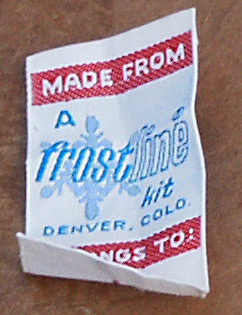 ARE THERE FROSTLINE SUCCESSORS?
--- UNFORTUNATELY, to the best of my
knowledge, no one is currently manufacturing complete kits like
Frostline, Holubar or Altra sold in the 1970s and 80s. By "complete"
I mean kits with all the material pre-cut; all the notions packaged
and ready; the down in neat little packets pre-measured for inserting
into each compartment; and a great set of instructions. This is
sad, and if any readers find a company currently making such kits,
please contact me asap! I have provided a number of links below
which can allow the persistent person to obtain the fabrics, fillings
and patterns from which they can sew up their own gear despite
the demise of Frostline and its kin.
ARE THERE FROSTLINE SUCCESSORS?
--- UNFORTUNATELY, to the best of my
knowledge, no one is currently manufacturing complete kits like
Frostline, Holubar or Altra sold in the 1970s and 80s. By "complete"
I mean kits with all the material pre-cut; all the notions packaged
and ready; the down in neat little packets pre-measured for inserting
into each compartment; and a great set of instructions. This is
sad, and if any readers find a company currently making such kits,
please contact me asap! I have provided a number of links below
which can allow the persistent person to obtain the fabrics, fillings
and patterns from which they can sew up their own gear despite
the demise of Frostline and its kin.
The closest modern cousin to
the classic kit companies like Frostline, Altra, or Holubar Kits
is probably a small company named "Thru-Hiker."
They offer a small selection of kits aimed at the ultralight backpacking
crowd. Note: although they provide all the raw materials and notions,
the pieces are not pre-cut (instead, you get a pattern), and the
down is not provided in those neat little pre-measured "applicators"
like Frostline or Holubar had in the good ole days. Thru-Hiker's
down is extremely high loft, can be purchased separately, and
is a good price.
Here are several Links
to the few but admirable companies now carrying on the Frostline
tradition---
The Rainshed <http://www.therainshed.com/>,
in Corvallis, Oregon, near Oregon State University (OSU)... this
is one of the most complete stocks of fabrics, patterns and notions
that one could ever desire, I myself have purchased from them
several times in the past...they've been around for many years
(I have their wonderful, thick 1993 color catalog)......Also in
Oregon, and also a place I've visited and purchased from in the
past, is Green Pepper <http://thegreenpepper.com/>,
which has been around since Frostline times in 1973---their main
products are all patterns for outdoor gear (also see mention of
them under Canvas Works).......In nearby Idaho state is Idaho
Outdoor Fabrics <http://www.owfinc.com/>,
which is a truly righteous successor to the Frostline heritiage,
with a huge selection and even bulk rates for big buyers. Note:
while they do carry patterns, they don't make true Frostline-type
kits...... Washingtonians in Seattle are blessed with Seattle
Fabrics (SeattleFabrics.com)
which stocks many of the very newest, most innovative materials,
such as Polartech Power Shield and Spandura. In the South Puget
Sound area is a great place in Olympia, WA called "Canvas
Works," <http://www.canvasworks.net/>
which carries a large selection of outdoor fabrics, including
the required zippers and other notions to put together almost
any pack, parka, or misc. piece of gear. They also carry a big
selection of outdoor clothing patterns from "Green Pepper"
.......Also try FabricLine/Rose City Textiles, a Portland,Oregon
company with a diverse selection of fabrics, patterns and notions--
on the web at fabricline.com <http://www.fabricline.com/>.
Note: although Fabricline carries many fabrics that could be used
to construct backpacking/climbing gear, I could find no patterns
that might apply to such sewing. However, Annette at Rose City
Textiles is really fun to talk with and very encouraging toward
any and all would-be outdoor gear creators.(Note: recently, Feb.
2010, the Fabricline website seems to have become only a "portal"
site-- readers with info. please tell me what has happened!)......A
new contributor has told me about "Rockywoods" in Loveland,
Colorado,http://www.rockywoods.com/
. Rockywoods has a wide variety of both classic and more modern
high-tech fabrics, plus a few kits, but not pre-cut kits, and
definitely not kits equipped with nice little down packets like
Frostline used to have!
Finally, I've had a number of inquiries
from owners of old, classic tents from various makers who have
needed some type of new pole, or pole repair parts-- they should
go to the "Tent Poles and Parts" section of QuestOutfitters.com,
based in Sarasota, Florida. They have many pole supplies, as well
as an excellent discussion....And for those in the Pacific Northwest,
a great place for custom poles and repairs is located in Vancouver,
WA; it is named .Yunan Aluminum pole company and has wide expertise,
ph 360-260-9527, website is PolesForYou.com.
Although the successors to the Frostline
tradition may be few and far between, they all seem to love their
mission.....
Skip directly to the topics of Mildew
and the break-down of the urethane coatings
on older outdoor gear such as tents and raingear.
Goose Down section:
First, How to Buy Goose
Down--- And
here's information sent to me recently by contributor Bill K........"Yes,
there are several online sources of good down. Thru-hiker.com,
which I mentioned previously, sells 800+ fill-power goose down
in 3-ounce bags for $29.95/bag plus shipping. This is excellent
down (I made the Whitney Jacket from the thru-hiker kit). Customer
service is as good as it gets. Also a good source for synthetic
insulation (Primaloft and Climashield) and ultralight fabrics.
Feathered Friends in Seattle will sell down, although they don't
advertise it on their web site. As of several years ago, the 800-fill
stuff was $8 an ounce in 6-ounce bags. They also sell what they
call "floor down," which is what they vacuum up after
a day of making sleeping bags. It's half the price, but not worth
the extra effort required, as it has to be washed and picked-through,
since it contains dust, pieces of thread, and possibly other foreign
material (I found a small piece of wood in the batch that I got.)..
I made a sleeping bag with it.
Also in Seattle,
recommended to me by Rainy Pass Repair, is Jack's Comforters,
recently renamed to ALL ABOUT DOWN. Jack Sukalac's card says,
"Down Specialists, Renovation and Repair." phone 206-784-3444.
They do sleeping bags, and could be a good place to take a classic
down bag that has some "issues."
And in November 2009,
Miki, who formerly worked for Frostline
in Boulder, told me about a firm named Lodi Down and Feather.
Skip directly to the topics of Mildew
and the break-down of the urethane coatings
in tents and raingear.
"An
Essay on Down"
ANCIENT KID'S RIDDLE: "How do you
get down off an elephant? Answer: You don't, down comes off of
ducks." [uproarious kids' laughter].
GOOSE DOWN was a key component of the
success of both Frostline Kits and Holubar Kits.... both companies
created innovative methods to package the down for consumer sewing
kits. Goose Down occupied center stage for decades during the
History of Gear. It was the clearly superior insulation of choice.
Even today, in 2020, despite the rise of interesting new insulations,
quality down remains the ultimate in most respects.
Down terminology--- down "fillpower"
is one of the main parameters that determines down quality. Down
with increasingly higher (better) fillpower costs more and more.
Cheap down in department store jackets often has only 450-500
fillpower, and it's duck down with lots of larger feathers and
feather shafts, etc. "Normal" down is goose down with
a fillpower of 550, as measured in the supposedly standard testing
cylinder-- under controlled conditions, how much volume will one
pound of down expand to fill up? Typical levels of better quality
down are 600, 650, 700, and then the ultra-premium 800-900. Some
folks doubt the truth of claims as high as 800+, but in my book,
having owned a bags with 800-850 fillpower down, as you get into
the highest grades, it's all mighty fine stuff, soft and luxurious
and heavenly light and compressible. You really can tell a big
difference, even over 550 down. The exact source of the down (the
birds) formerly was held in great esteem, with eider down and
Polish down being regarded as the ultimate, but nowadays many
say it doesn't really matter where it comes from, as long as it
passes the tests, one down is as good as any other--- and nowadays
most of the World's down comes from geese raised for meat in (you
guessed it) China.... A Final author's note: the ultra-premium
down bags of Feathered
Friends and Western
Mountaineering both use 850+ down from Eastern Europe.
August 2020: For a very deep dive into
the very latest tech about down, you should treat yourself to
the extensive material at what is arguably THE SOURCE about down:
modern standards, sourcing, doing it sustainably: AlliedFeatherandDown.com (Matthew Betcher, Creative Director)
The Proper Storage of
Down Gear-- Here are
some storage tips:
Packing loosely is the right thing to do. Never store your down
bag or garment tightly compressed into its stuff sack or compression
sack.....Down-filled articles need to need to breathe freely to
avoid any build-up of damaging water vapors. Thus
storing inside things like plastic garbage bags is a distinct
no-no. A cotton storage bag usually comes with any new, quality
down bag and is the best thing. If you don't have one of those,
take an old sheet, queen size
is good, and create a makeshift storage sack out of that, tie
the top shut
with a piece of cordage.
Storage needs to be in a dry, cool place. Attics are bad, especially
due to the extreme
heat that occurs during the summertimes. There's enough heat up
there in the summer to kill any average duck or goose! Normally,
inside the house in the back of a closet is a perfect spot, UNLESS
the closet is subject to excessive humidity build-up.
Washing of sleeping bags
and parkas-- the cleaning of older down garments and sleeping
bags--- this is an important subject.
It is related to the general topic of not destroying your expensive
down bag by misuse and abuse. The picture below shows one of the
terrible things that can result. This classic Sierra Designs Superlight
bag has suffered an interior baffle tearing loose. The bag baffle
had knotted and trapped a big clump of down. It was like a tumor
inside the bag, so I did surgery through a 1.5 inch long slit.
This kind of damage can be the result of over-vigorous stuffing
and unstuffing, or perhaps from too many gymnastics inside the
bag. It can also occur during the process of washing the down
sleeping bag.... The brief warning is NOT to dry clean or machine
wash older down items, IN PARTICULAR sleeping bags with their
delicate interior structures of baffling...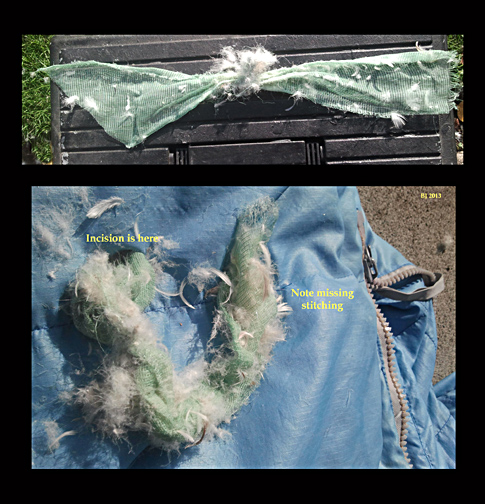 Hand washing with a good down soap is the method
of choice. The key word is GENTLE, GENTLE, GENTLE. ... IF you
must disregard my cautions, use only an appropriately-sized front
loading machine and mild soap, and dry on a verified minimal
heat setting in a large commerical dryer, with lots and lots of
big dry towels to cushion and absorb moisture. Remove item from
dryer frequently and very carefully and very gently pull apart
the big wads of clumped-up wet down, then continue drying. Be
prepared to spend at least two hours for drying of larger down
items like sleeping bags. If you have a truly valuable collector's
vintage bag like an old Holubar Expedition bag, or anything that
is both old, and collectible, I highly advise that you spend the
money (est. $30-40, plus shipping both ways) to have the bag professionally
done by a specialist like Rainy Pass Repairs-- and PLEASE be prepared for the possible news that the washing may not be possible if the internal
baffling and/or the stitching holding it has become weak or rotted
due to age and hard usage (see my page about Repairs
of Vintage Gear).
Hand washing with a good down soap is the method
of choice. The key word is GENTLE, GENTLE, GENTLE. ... IF you
must disregard my cautions, use only an appropriately-sized front
loading machine and mild soap, and dry on a verified minimal
heat setting in a large commerical dryer, with lots and lots of
big dry towels to cushion and absorb moisture. Remove item from
dryer frequently and very carefully and very gently pull apart
the big wads of clumped-up wet down, then continue drying. Be
prepared to spend at least two hours for drying of larger down
items like sleeping bags. If you have a truly valuable collector's
vintage bag like an old Holubar Expedition bag, or anything that
is both old, and collectible, I highly advise that you spend the
money (est. $30-40, plus shipping both ways) to have the bag professionally
done by a specialist like Rainy Pass Repairs-- and PLEASE be prepared for the possible news that the washing may not be possible if the internal
baffling and/or the stitching holding it has become weak or rotted
due to age and hard usage (see my page about Repairs
of Vintage Gear).
SLEEPING BAG TEMPERATURE
RATINGS AND SLEEPING BAG LOFT--- The
scoop on Sleeping Bag temperature ratings, the best method for
an average consumer without expensive testing lab equipment is
to lay out the subject sleeping bag for several days to become
fully fluffed-out. Then take a normal 12 inch ruler and gently
shove it up against the side of the bag, about where your ribs
are. Carefully sight a level line, most likely you'll see a reading
of somewhere around 4 to 8 inches.
5 inches would be good to about 25 degrees
for an average sleeper, assuming the bag doesn't have any broken
internal baffles with big cold spots resulting.
6 inches good to about 15
7 inches good to about 5
8 inches good to about 10 below
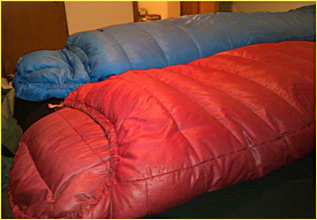
Shown below: the ruby red bag is a 1972
Snowline bag with 7.4 inches of loft, vs. a blue 1965 Holubar
Expedition Royalight bag with 9.3 inches of loft. "Snowline"
was the original name chosen by the founder of Snowlion, but lasted
only briefly due to conflict with the prior users of the name
(Eddie Bauer)
Important Notes:
As the temperature falls into the frigid ranges, other bag construction
factors become more and more important, either adding to, or subtracting
from, the amount of loft the bag possesses. Eg. If the bag has
an excellent hood
Design, that helps. Eg. If the bag has a down-filled draft collar
around the shoulders, that can help a lot. Eg. If the bag has
a vapor barrier liner, that can add a good 10 degrees to the temperature
rating, especially on the 2nd and 3rd and 4th nights out in frigid
temps. Eg. If the cut of the bag is spacious, that subtracts from
the temperature rating. Eg. If the zipper baffle area is not well-designed,
that will result in a nasty cold spot. Eg. If you’re sleeping
out in the open, any amount of breeze will subtract from your
rating, and what will help bring it back up is a good bag cover,
Goretex or any other good wind barrier. Eg. Ground insulation---
a really big factor is the adequacy of your ground insulation;
it takes ever-increasing thickness and R-value as the temp drops
to zero and below, especially on snow or ice. Pad technology took
a huge technological leap in the early 1970s when the Thermarest
pads where invented.... Eg. Related to this, your temperature
rating goes to hell if you keep rolling off your ground pad during
the night, so bag systems that are designed such that the sleeper
cannot roll off are much better under severe cold conditions (eg.
The Warmlite Triple Bag with a built-in
pad or the new bag systems from Therm-a-Rest like the Altair sleeping
bag). Therm-a-Rest XTherm
pad, thermarest XTherm sleeping pad is the best for combining
light weight, small bulk and high R value.
Let me know your measurement results,
please!
Bruce Johnson
July 2021
MILDEW and URETHANE:
URETHANE COATINGS
BREAK-DOWN: ISSUES AND SOLUTIONS:
Now, onto that evil subject of URETHANE
DEGRADATION.
It's a common problem usually hitting 20+ year old urethane-coated
fabrics. ... High humidity storage is often a factor, as is high
heat storage, as found in hot attics. On the other hand, I've
seen 40-50 years old urethane still in fairly good condition on
tents and other items that were stored in unheated garages in
the high-altitude, low-humidity environments of Colorado's mountains.
The sticky stage is often the first stage
of the decomposition process, often accompanied by an "off"
smell. I recently was sent a badly-afflicted Moss Encore tent
in this stage. It arrived in a big box as a glued-together blob
that took me quite a while to pull apart and figure out which
was the floor, which the canopy, how to get into the door, etc.
That tent had been stored for 20 years in a closet next to a wood
stove flue, in the State of New York. It was mostly the excessive
heat that had destroyed it, in my analysis.
In the middle stages of decomposition,
there is often a white-powdery look to the urethane side of the
fabric, and most of the stickiness is gone.
In the final stages, the coatings lift,
bubble, and peel off... At that point, one can vigorously rub
the coatings off, then wash vigorously and use the item as an
uncoated item..(I've done this with vintage packs)........Note
also: If your rainfly has been hit, probably your tent floor is
also on its way out (although it could be of a different weight
nylon and part of an entirely different batch of fabric that had
better-applied coatings in the first place).
..... Attempts to recoat old fabric are
marginal at best, although at least one experienced vintage collector
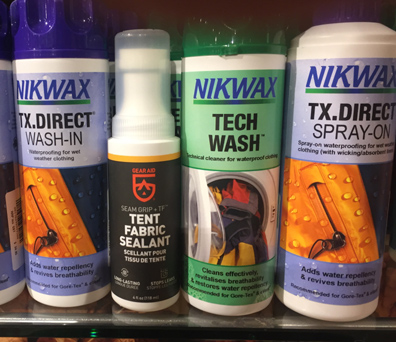
recommends GearAid brand "Tent Floor Restorer."... In
recent years Nikwax has also put out a line of restorative products
that might be helpful. Nikwax "Solarguard" seems to
live up to its claims when treating an early 80s Goretex canopy
on an Early Winters tent, but the real challenges are those deteriorated
urethane tent floors and rainflys. Nikwax "Seam Grip tf"
is reputed to be helpful. A cheap treatment is Ammonia; household
ammonia, rubbed vigorously into the sticky stage and then thoroughly
rinsed-off with plain water seems to remove the worst of it, but
then your items will have much less rain repellency. Also, nearby
fabric lacking urethane coating may possibly get adversely affected-
so test on a small inconspicous section first!.....If any of you
try any of the fairly expensive Nikwax or Gear-Aid products, please
let me know so that I can post results for others (oldgear@Oregonphotos.com).........
Darn that urethane! When it goes belly-up,
your tent, or more specifically, the parts of it that are urethane-coated,
are ruined insofar as keeping out the water. It is the inevitable
fate of all of the old urethane-coated fabrics-- in somewhere
between 15 and 40 years, the coatings begin to get sticky, smell
odd, and begin to peel off. There is no real fix other than to
send your tent to an expert repair place who will install a whole
new waterproff floor, and make you a whole new fly. Do you have
$300 or $400 to do that? No, nobody does, so just know that the
basic nylon fabric under the coatings is still strong and just
isn't waterproof anymore.... Sometimes people just entirely scrub
off the old coatings (some use an ammonia solution), and then
lay down a good groundsheet to bolster a tent floor with decomposed
urethane.
There are some recent products made that
brush-on over the decomposing urethane, like the aforementioned
Nikwax Tent Fabric Sealant, aka "Seam Grip tf" but its
efficacy has yet to be proven to me, especially in later-stage
decomposition where the urethane is flaking and peeling, and therefore
has little "grip" on the foundation fabric (often 1.9
oz. ripstop nylon or 2.2 oz. tafetta nylon).
Since rainflys do not need to be waterproof
under the pressure of bodies and boots lying on them, they can
be saved, more or less. Just use a good silicone waterproof spray
on the non-urethane side. Allow plenty of time outside in warm
temps for it to dry and all the silicone odor to dissipate. You
can try stripping off the urethane by washing the fly-- use a
good front loader. Be sure to take off the guylines first.
Use the Silicone spray after you are done (or go to an REI and
buy some of the other (fairly expensive) water-proofing products.
Tent rainflys are just suspended above a
tent, and so they'll do a decent job keeping the rain off even
without a urethane coating because the raindrops are not being
pressed through the fabric by bodies and boots. That is why your
common umbrella is not made of coated nylon; it's just uncoated
fabric held more or less taut by the umbrella structure. (by Bruce,
aka oldgear, July 2020)
MILDEW ON YOUR GEAR:
I have received distressed
emails about old tents attacked by mildew many times. Often the
issue is mildew damage; sometimes, worse yet, it is mildew combined
with aging urethane coatings that are getting smelly and peeling
off. Of course, other types of gear get mildew, but tents seem
to be especially vulnerable, usually because they are most prone
to come back from a trip wet or moist, they are large and cumbersome
to dry out, and then they get stored tightly rolled for long periods
(best to store loose and breathable cotton sacks, like sleeping
bags).
Mildew is a terrible
problem, especially
when it has attacked goretex fabric because anything strong enough
to kill the mildew and bleach out the spotting can potentially
damage the adhesives holding the goretex to the ripstop nylon
fabric. Tents with integral double-wall designs present another
type of issue in treating the mildew: it's the double-wall construction,
where you cannot get to both sides of the fabric.
What I've done personally
when I am just determined to keep the affected gear is to thoroughly
wipe down the fabric with 91% rubbing alcohol applied with many
paper towels, which I use to scrub away whatever dissolves in
the alcohol plus the incidental surface dirt (apply inside and
out, if needed). Then dry very thoroughly with tent set up in
hot sun (or at least some sun and over 60 degrees). Then apply
a silicone spray of high potency (cans usually labelled something
like "heavy duty" or for specially for tents and tarps.
A tent will require at least one, probably two spray cans at $7-10
apiece. What you'll be left with is a re-waterproofed tent with
unattractive mildew spots that are dead; the odor should be gone
UNLESS the odor is in part or entirely due to urethane degradation
(see the link above). Although I hate to tell you this, most tents
20-30 years old are likely to be suffering some degree of degradation
of their urethane coatings on floor, vestibule and rainfly....
COMMERCIAL PRODUCT: Some
of my correspondents have had some success with a product made
by Gear Aid called "Odor
Eliminator." The
active ingredient vs. mildew is "MiraZyme." I have not
used it myself. The package talks about it eliminating the bad
odor; however, the extent to which it actually permanently kills
the mildew is unclear to me, and also the extent to which it lessens
those ugly mildew spots and stains is unclear. Anyone who uses it, please report result to me!
(oldgear@oregonphotos.com)
Finally, if you don't
want to try Gear Aid's product, you can just try the easy way--
remove ALL guylines and wash the mildewed item with your Tide
w bleach, in a large front loader (go to laundramat if needed).
Do not dry in a dryer, just hang it up or set it up to dry very
thoroughly. BEWARE: if you have an older, mildewed
down sleeping bag, you are at great risk machine washing-- use
hand washing only, as I described further up this page! And if
the mildew has gotten into the down itself, you might as well
throw that poor bag away!
NIZORAL (Ketoconazole)-- A contributor named
Bobbi writes: "Regarding stinky gear. I am now 60 and I still
backpack, box, and practice Jujutsu. Years ago I found an antifungal
shampoo called Nizoral A-D Anti-Dandruff Shampoo. It used to be
prescription but now can be purchased at a limited number of drug
stores and at Amazon. This stuff is amazing at killing and removing the odor from gear
that gets damp, and growing smelly organisms. I use my boxing gloves about six hours a week,
and they get wet every time as I sweat heavy and work hard. The
padding almost never gets a chance to dry out. I mix about two tablespoons of shampoo in a bucket
of water and massage
my gear to saturate the fabric. I leave this overnight and then
rinse the next day, thoroughly. The best part is, I don't seem
to have to retreat for five years! I assume some residual shampoo
is still in the product. I have had Jujitsu partners that had
shirts that stank even after they washed them in bleach, try this,
and get the shirts smelling fresh. I have used it on my gloves,
shin guards, hand wraps, and shirts. Love this product. It might
be worth trying this on tents by soaking them in a bathtub. It
would seem better on them than a front load washer? Worth a try.
Readers! Let me know
how any of these solutions turn out for you, please! oldgear@oregonphotos.com
WOOL:
ANOTHER TRADITIONAL INSULATION is wool, usually from sheep. It
has been deeply discounted and even maligned since the rise of
modern synthetics, but wool has kept people warm for ten thousand
years in some of the World's nastiest climates so must have some
virtues. A small family-owned company in the mountains of Sweden
has been producing a high tech form of merino wool since 1972,
naming it "Ullfrotte' Original." They form it into a
complete lineup of base and midlayer garments. Gary Neptune of
Neptune Mountaineering highly favors Woolpower. The garments can
even be machine washed and machine dried... Contact: info@woolpower.se,
or their website at www.woolpower.se
copyright Bruce B. Johnson 2006-2022.
Reader input is
welcome.
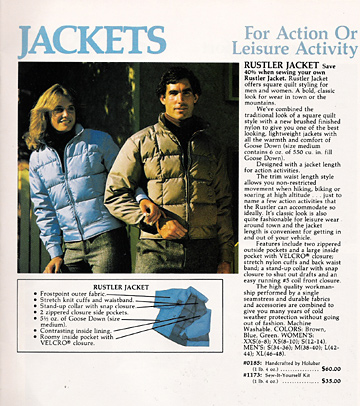
Shown is a Holubar Kits "Rustler"
down jacket kit, which was a sewn-through construction. Those
of us who were more daring and skilled sometimes would take such
a kit and meticulously add baffling material between the inner
and outer fabrics, thus creating a much warmer and infinitely
more "braggable" personal creation.
...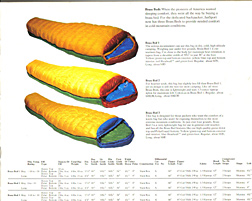
Shown is the JanSport "Brass Bed"
series, which featured down tops paired with Polarguard bottoms.
This unusual design was meant to maximize the powers of down,
while minimizing down's two main weaknesses-- compressibility
under body weight, and poor performance when wet or damp.
Please Note: All Material above, and in all my "History
of Gear" webpages, is copyrighted, and no usage of my material
is permitted unless explicit permission is granted by me, Bruce
B. Johnson, owner of OregonPhotos.com. ... Editors: Please contact me if you have interest
in publishing....Others: if you were involved
with one of the old-line, vintage gear companies and have a story
to tell in these pages, please contact me soon at oldgear@oregonphotos.com
WWW.OREGONPHOTOS.COM

Page last revised 12/20/2021