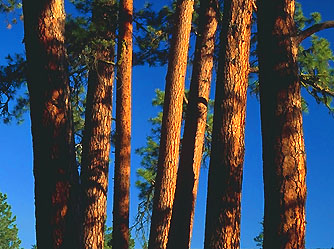
The remoter reaches of Eastern Oregon are sun-drenched landscapes of great beauty and variety. Juniper and sage cover the lowland canyons, and ponderosa pine beautifies the mountains. This zone lies generally east of Madras. The Ponderosa grove shown above is just south of Seneca and north of Burns... Such immense stands of virgin "yellow pine" are what turned Seneca into a lumbering boom town for many decades. Click link for more detail.
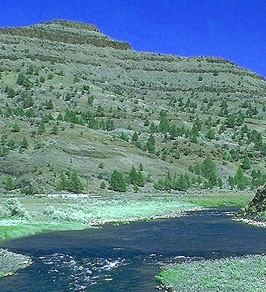
The John Day River is one of this region's treasures. It's seen above near the tiny community of Spray. The climate in this canyon region is unique and unnusual, being much warmer in the winter than the majority of Central and Eastern Oregon, and truly scorching hot during the long summers. Unlike the majority of Central and Eastern Oregon where warm days are followed by cool or even chilly nights, this canyon region remains warm at night. It grows great orchards of fruit at Kimberly, unaffected by the nasty summer frosts that limit agriculture elsewhere in Central and Eastern Oregon. In fact, Spray is so hot that it may hold OREGON'S RECORD for the longest consecutive number of days where the daytime highs exceeded 100 degrees. During the summer of 1971, Spray recorded 26 consecutive days over 100 degrees. Click here to visit my Oregon Climate pages which have more information on this subject...... Or click here to see a Wheeler County Ghost town!.... Also, be sure to see my coverage of the bizarrely beautiful Painted Hills near Mitchell.
Among foresters and others who study such things, it is well-known the the State of Oregon harbors quite an undue share of the largest specimens of various trees, both evergreen and broadleaf.
Oregon's largest
Ponderosa pine tree is located 80-100 air miles southwest of Seneca.
It's a giant named "Big
Red," and
it lives in LaPine State Park, south of Bend and near Sunriver
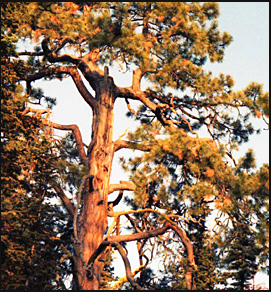
(the image below is not Big Red-- it's an old, twisted
Ponderosa that I discovered far off a road at about 5000 feet
elevation in the mountains near the Badger Creek Wilderness).....
" Big Red"
is far larger, and straighter-- it towers more than 160 feet tall,
is 29 feet in circumference (9.2 feet in diameter), and is about
500 years old...Oregon's
tallest Western Juniper lurks about 70 miles to the southeast of Big Red,
hiding in the amazing 9000 acre relict forest named The Lost Forest;
it's a gnarled monster 68 feet tall.
Big Red"
is far larger, and straighter-- it towers more than 160 feet tall,
is 29 feet in circumference (9.2 feet in diameter), and is about
500 years old...Oregon's
tallest Western Juniper lurks about 70 miles to the southeast of Big Red,
hiding in the amazing 9000 acre relict forest named The Lost Forest;
it's a gnarled monster 68 feet tall.
Back West of the Cascade Range, among the trees favoring the wetness of Western Oregon, is Oregon's largest Douglas Fir is located in Oregon Caves National Monument. .. It's a coastal Douglas Fir.... And Oregon's largest tree of all, a coastal Sitka Spruce can be viewed at this link! If you are interested in Oregon's big trees, you'll find information about other specimens once you get onto these other pages!M
MoreMM. Vernon, Mitchell and Prarie City are close.