 Credits:
I would like to acknowledge the kind of generous help I've received
from Mr. Kelty's son, Richard Kelty.
Credits:
I would like to acknowledge the kind of generous help I've received
from Mr. Kelty's son, Richard Kelty.Dick Kelty is the man
behind the bigger-than-life Kelty brand. Mr. Kelty was a humble
carpenter who began to make packs in his home in the very early
1950s, with the help of his wife Nena... Thus, within the history
of gear, Kelty started as another husband/wife team like GERRY,
like Holubar, like Downhome, and like Stephenson's Warmlite....Mr.
Kelty's first year of real business was in 1952, when he sold
29 packs! Credits:
I would like to acknowledge the kind of generous help I've received
from Mr. Kelty's son, Richard Kelty.
This author's first "real" pack was a no-name frame pack in a greenish fabric of some kind, but definitely not the renowned Kelty nylon (click here to see this pack in action circa 1965)...... By the mid-1970s, I proudly owned a Kelty BB5 pack. My shoulders and hips still recall backpacking into the Tetons in 1978, proudly hefting a 76 pound pack, fully half my weight! Those Keltys easily provided the capacity to go "Mega-weight" rather than "Ultra-light."
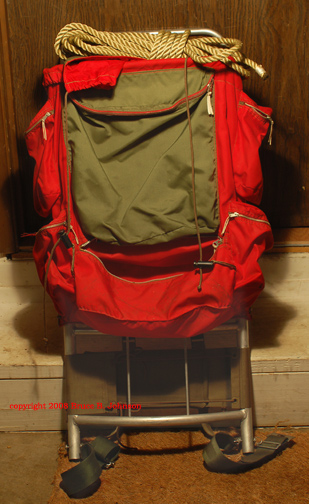
The picture to the left shows a Kelty D4 packbag mounted on the Mountaineer frame, with the stainless steel quick release waist belt buckle. If you've ever carried one of these big frame packs in a dangerous place, such as crossing a slippery log above a rushing stream you know why the "quick" release buckle might be an improvement that you really wanted! There are some optional add-ons to this pack, namely the big extension bar across the top of the frame to which you could strap on tons of extras, such as a big coil of Goldline climbing rope. The D4 packbag has a large, undivided upper compartment with a hold-open bar, and a small, zippered lower compartment (too small for anything but a very slim summer down bag)... Also, this particular packbag has two of the big extra pockets (green) sewn on by the factory as options. This vintage on this pack is 1970 or 1971. It has held up well, but the foam padding in the shoulder straps has become as hard and stiff as two wooden boards! (note: such degradation doesn't always happen; a prime cause is a pack being stored in a boiling hot attic for years on end; the hot dry heat is death on foam).
Original prices: the Mountaineer frame was $27. Frame extension bar was $3.85. Packbag (D4) was $..... The large back pockets were $3.25 each.
On top of the pack, demonstrating the virtues of having an extension bar, is a coil of GOLDLINE ROPE. This nylon rope was the standard rope when I began climbing in the mid-1960s. in 2010, much to my surprise, a correspondent told me that Plymouth Cordage compan, the original manufacturer had been gone for a long time, but that some other American was still making Goldline, one of its main markets nowadays being cavers! This fellow sent me a brand-new 20 foot length! However, I could not find any such company selling Goldline in 2012! Click here for description and pictures of other early ropes used by climbers.
The
image below shows the backside of the same pack. The Mountaineer
frame can be identified by its having five crossbars. The Backpacker
frame had four crossbars and cost $2 less....The picture of the
person wearing a pack is again the Mountaineer frame, but now
with the "BB5" packbag attached. The BB5 was this author's
favorite Kelty pack... It's single gigantic compartment allowed
one to just throw in monster loads of odd sized things. 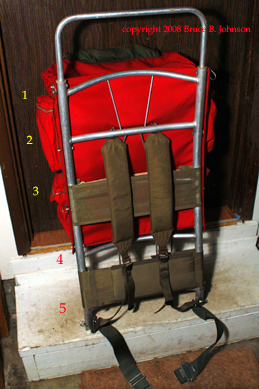 The usual way to pack
a BB5 was to load up the main compartment with food, clothing,
camera, etc. Then ones sleeping bag and pad went on the bottom,
and ones tent was attached across the top, using the extender
bar for a stabilizing brace. Maybe you also threw on your climbing
rope and ice axe, too! That extender bar was also darn useful
for just grabbing onto the beast and swinging it onto ones back.
Ah, to be so young and strong again!
The usual way to pack
a BB5 was to load up the main compartment with food, clothing,
camera, etc. Then ones sleeping bag and pad went on the bottom,
and ones tent was attached across the top, using the extender
bar for a stabilizing brace. Maybe you also threw on your climbing
rope and ice axe, too! That extender bar was also darn useful
for just grabbing onto the beast and swinging it onto ones back.
Ah, to be so young and strong again!
Dick Kelty within
The History of Gear was a part of what I call the California
group of early pioneers. Others from that same time frame
include Jack Stephenson of Warmlite, and Ralph Drolinger
of A16 Packs, aka Adventure 16...... Mr. Kelty was known as
an inventor and a person who always genuinely "walked his
talk" as a true outdoorsman. 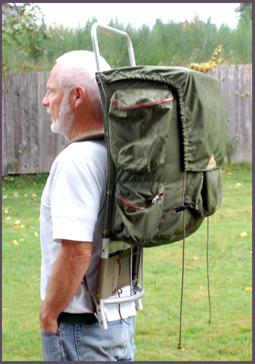 Many grant him the title of "The
Father of the frame pack." Although some dispute some
of the claims, what is certainly true is that he had many innovations
in backpack design that improved weight-carrying and improved
comfort. Some claim that he introduced the first aluminum frame
backpack, the first waist-belt, the first padded shoulder straps,
the first nylon pack-bag, the first zippered pockets, the first
hold-open bar; and the first use of clevis pins. Whether he was
truly "first" in all these categories I cannot say,
but what is most certainly true is that Mr. Kelty was a giant
among the gear pioneers, and through his efforts gave backpacking
an early and long-continued boost into the national consciousness
of the United States.
Many grant him the title of "The
Father of the frame pack." Although some dispute some
of the claims, what is certainly true is that he had many innovations
in backpack design that improved weight-carrying and improved
comfort. Some claim that he introduced the first aluminum frame
backpack, the first waist-belt, the first padded shoulder straps,
the first nylon pack-bag, the first zippered pockets, the first
hold-open bar; and the first use of clevis pins. Whether he was
truly "first" in all these categories I cannot say,
but what is most certainly true is that Mr. Kelty was a giant
among the gear pioneers, and through his efforts gave backpacking
an early and long-continued boost into the national consciousness
of the United States.
Asher "Dick" Kelty passed away in January, 2004 at his home in Glendale, California of natural causes. He was born in September, 1919 in Duluth, Minnesota....Instead of a memorial services, he issued now-famous words encouraging everyone to "go take a hike." ..... His company carries on.
Remarkably different than the Kelty company has been the business course of former associate/rival, the small custom gearmaker Stephenson's Warmlite, which has survived, stayed tiny, and never changed its name or ownership in some 40 years of doing business! A little-known fact in the History of Gear is that Stephenson was selling a frame pack with a fully-padded waist belt system well over ten years before Kelty packs had them!
ALERT: MY BOOKS ABOUT FROSTLINE KITS and GERRY MOUNTAINEERING ARE NOW PUBLISHED. PLEASE VISIT MY FROSTLINE PAGE IF INTERESTED. NEAR THE TOP OF THAT PAGE YOU WILL SEE A "BANNER" THAT YOU CLICK ON TO GET TO MY PUBLISHER. NOTE: My most recent book covers the story of one of the true giants in the history of American gear-- Holubar Mountaineering and its kit-making offshoot Carikits. Also finished as of 2018 are books about the history of MSR and Stephensons Warmlite.
Please Note: All Material above, and in all my "History
of Gear" webpages, is copyrighted, and no usage of my material
is permitted unless explicit permission is granted by me, Bruce
B. Johnson, owner of OregonPhotos.com. ... Editors: Please contact me if you have interest
in publishing....Others: if you were involved
with one of the old-line, vintage gear companies and have a story
to tell in these pages, please contact me soon at: brucej@Oregonphotos.com
