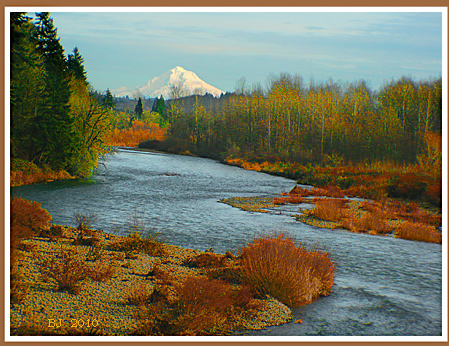
It's the Climate that around 70%
of the State's citizens live with, day to day, week to week, and
year to year.
It's the Climate which dominates Oregon's six largest cities.
It's the Climate of that portion of Oregon commonly referred to
as "Oregon" in the national consciousness, and the Oregon
most-portrayed by travel and tourist bureaus.
You get the picture, I'm addressing the climate that affects most
of Oregon's residents!
The "in-denial" picture
of Northwestern Oregon's climate is that of one of the World's
best climates---
As in the picture above, a cool, lush, green Paradise on Earth.
That vision is like a figment of the parched collective memory
of Oregon's Pioneers. 150 years ago, they spent long months crossing
enormous hostile deserts and steppes to arrive in the Promised
Land of the fertile Willamette Valley. Psychologically, how could
anyone find it in themselves to hate the climate of the Promised
Land given the high cost of the journey-- the despair and the
litany of deaths that occurred along the Trail? (see also
sidenote at page bottom)
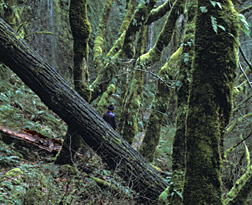 What
is striking about Oregon's climate is not just the sheer amount
of rain, but the persistence of the rain. A newspaper feature
that Oregon's tourist bureaus would rather forget about documented
that among the US's major cities, Portland, Oregon showed the
most hours per year when rain actually fell from the sky- a bit
over 1,000 hours per year. This is a fact of life that Oregonians
know all too well--those gloomy days where it rains a microscopic
drizzle most of the day, shutting down outdoor activities like
mowing your lawn or working on your car, and yet when you pull
off your soaked shoes and sit down to listen to the evening news,
fantastically, the weatherman reports that it rained only 0.05
inches, when it seemed to you like everything was oozing water
all day long! Then of course there are long stretches of time
where it stays gray and overcast, but doesn't rain. This aspect
of the climate appears in Oregon author Don Berry's award-winning1962
novel "Moontrap" (quoted below, click
here).
What
is striking about Oregon's climate is not just the sheer amount
of rain, but the persistence of the rain. A newspaper feature
that Oregon's tourist bureaus would rather forget about documented
that among the US's major cities, Portland, Oregon showed the
most hours per year when rain actually fell from the sky- a bit
over 1,000 hours per year. This is a fact of life that Oregonians
know all too well--those gloomy days where it rains a microscopic
drizzle most of the day, shutting down outdoor activities like
mowing your lawn or working on your car, and yet when you pull
off your soaked shoes and sit down to listen to the evening news,
fantastically, the weatherman reports that it rained only 0.05
inches, when it seemed to you like everything was oozing water
all day long! Then of course there are long stretches of time
where it stays gray and overcast, but doesn't rain. This aspect
of the climate appears in Oregon author Don Berry's award-winning1962
novel "Moontrap" (quoted below, click
here).
A less obvious betrayal of the NW Oregon climate is the devious placement of its sunniest, driest weather. The area has only a paltry 60 or so "clear" days per year to begin with, and sun-starved folks would love to be outdoors during them! But the sad fact is that a majority of Oregon's clear days with no rain occur during stretches of blistering summer heat-- it's a comparative rarity to have clear, dry weather that is mild and really comfortable. This is because only the period from about July-September experiences more than a few days per month of clear weather, but July-September is normally when the sun is intense and thermal lows from the Southwest are creating the weather, and together they conspire to create a HOT sun and highs during the clear/dry/hot spells in the general range of 86 to 100 degrees, with a record high for Portland of 107 degrees..... Even more deviously, many of Portland's remaining clear days tend to occur during the winter when nasty east winds up to 40-60 mph roar down the Columbia River Gorge from high pressure areas in Eastern Oregon/Eastern Washington (so-called "Gorge Winds").... Such air tends to be cold, and with high winds day and night, wind chills are often severe, making residents wonder if the clear skies are really an improvement over calm, gray drizzle! Springtime is often quite disappointing, see my webpages GloomySpring 2003 and Gloomy Spring 2005. At times even June can be mostly cloudy and cool, like June 2010 was. And more rarely, summer may fail to arrive in any real sense of the word, for example in the record-setting summer of 1954, when the temperature never went over 90 even once, and there were only ten days in the whole year of over 80 degrees!
If Oregon's climate were to magically change, I would vote for moving the majority of the clear, dry days to the month of April. Now one could experience a pleasantly warm sun, with air temperatures in the 60's-- that would really be a Paradise on Earth! But in Northwestern Oregon many Aprils come and go with zero to two clear days in the entire month!
The overall effect of Oregon's pattern of stuffing so many of the year's clear days into the summertime is that many of the clearest, driest days are not very pleasant. In a final slap in the face, if the heat drives you toward water sports, when you come up for air shivering, you quickly realize that Oregon's waters remain cold even in mid-summer--it's the by-product of the underlying cool, wet climate and of the many high snow-capped mountains that feed the rivers and lakes! And while we are on the subject of COLD water, we ought to discuss that crazy tourist mecca out there on the Oregon Coast.... Despite those pictures of children frolicking in the ocean and surfers riding the waves, do not be deceived! The North Pacific waters that lap Oregon's beaches are fed by a branch of the sub-arctic Aleutian Current, perpetually cold, totally unaffected by even the rare heat wave that reaches the beaches from hotter parts of Oregon!
What is positive and true about the climate of Northwestern Oregon is the near-absence of the "Horror Weather" that afflicts much of the rest of the United States--- horrendous floods, flashing thunder and lightning, hailstones big as eggs, huge tornados, hurricanes, monster blizzards, dripping summer humidity, and hordes of nasty biting flying bugs--- all are rare or non-existent in Northwestern Oregon. Relief from "Horror Weather" is a very big blessing that helps one to live with the monotonous Gloom, and to accept with better grace the occasional blistering summer heat waves or wintertime Gorge winds.
Cliff Mass is a professor of Atmospheric Sciences at the University of Washington. I've contributed some of my research regarding the Pacific Northwest's coldest spots (eg. Seneca) to his recent book.
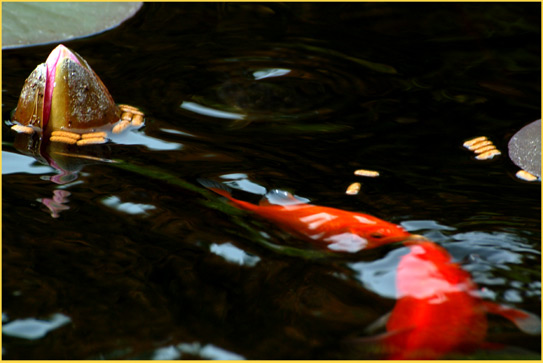
Dr. Mass has described an overall feature of the Northwest's climate that I wish to amplify on. He states that the yearly progression of the Seasons in the Northwest can be quite tough to live with. I call it, "Slow to the Good, Rush to the Bad." To explain: On the early end of the year, the progression out of winter and into spring, and then into summertime is agonizingly slow, with even June often being mostly cloudy, cool and wet (click for proof). In fact, Dr. Mass sees clear, dry, stable summer really not arriving until the second week of July.... But on the late end of the year, the progression out of summer and into fall and into winter is usually depressingly rapid. Often October can start out with nearly summertime high temperatures, sun and dryness, but by November 1 the region has virtually skipped Fall, and gone straight into winter-like storms, with unending clouds, cold rain, and big storms. When I think of the Northwest, I think of water, deep depths, growing things, water mysteries, like in this scene in my backyard pond. The tan pellets are ordinary fish food, but the effect is extra-ordinary indeed.
My personal experience with Northwest weather has including living in a large variety of the Northwest's regions, all the way from Medford, Oregon, to Eugene, to Portland, to Bend, to the Eastern Columbia River Gorge, and to the Puget Sound area. While I believe that Dr. Mass' generalization is true for the entire region, there are distinct variations, the pattern of which runs vividly north to south; eg. Medford moves into clear, dry summertime conditions much earlier and stays summerlike for much longer per year, while Portland has very much the pattern that Dr. Mass describes, while the Puget Sound area can, during some years, have so little dry, sunny summer weather that it's almost like true summer never came. For a very related discussion, please see my discussion of Mediterranean climate in the Northwest.
Bruce B. Johnson
Copyright 2005-2021
All Rights Reserved

Oregon's first
major inrush of settlers encountered a Willamette Valley paradise
that was much drier and sunnier than normal. The decade of the
1840s still holds the record as the worst drought ever to afflict
our State.
But "Drought" in the Willamette Valley is a relative
term. With deep, fertile soils and extensive native cover of trees
and tall grasses, the Oregon Trail settlers of the 1840s saw fields
of green everywhere despite the underlying drought. With normal
yearly rainfall an ample 35 to 45 inches, even quite sub-normal
rainfall is still enough to keep streams, rivers and green grass
alive for much of the year, and there were so few people that
overuse of water tables, and urban water shortages weren't even
conceivable.. Then, too, one must remember that even a drought-stricken
Willamette Valley looks very green and lush compared to the brutal
deserts and steppes that settlers had traversed to reach the Willamette
Valley.
So Oregon's early settlers adjusted with pleasure to an abnormal
climate, a more sunny, dry climate that favored grasslands and
oak trees, quite similar to what one finds nowadays in the Roseburg
and Grants Pass areas. But then the 1850s rolled in, and with
it came the normal endless rains and clinging clay mud, and long
months of gloom. One can imagine the thoughts of the settlers
who'd come on the first wagon trains, joyfully staked their donation
land claims, and built their new homes. No matter how crummy the
weather had become, they knew they were now "locked in."
Now they had to learn by heart how to spell that native Oregon
word, "SADS." * Click here for an eeriely appropriate quotation
from "Moontrap," by Oregon author Don Berry. The Award-winning
1962 novel's action is set very fittingly in 1850.
* Behavioral scientists
at Oregon Health Sciences University are credited with the original
research that led to the naming of "Seasonal Affective
Disorder," SADS for short-- moody, down, gloomy, depressed,
irritable, and hungering for heavy rich food and COFFEE to get
through the sunless weeks of winters without end.
In Don Berry's award-winning book, Johnson Monday is a mountain man struggling to fit in to the lifestyle of a farmer in the 1850s era Willamette Valley... His homestead is situated on a river bend about 20 miles north of the picture at the top of this page.
Mr. Monday's thoughts
turn to the climate of Northwestern Oregon near Oregon City. In
this passage, he's speaking with a Frenchman, named Devaux, who
is a former Hudson's Bay employee... Monday begins, "Why
the hell is summer so much better than winter?" (Devaux's
reply) "It is a question of light, here there is no light,
eight months a man lives with no light, and [suffers] the wet
and the cold." (Monday replies) "Y'know, every winter
I think I can't stand it any more, I figure I got to leave. But
I'm too damn low t' do it in the winter, an' when spring comes,
it's so good I forget all about it." (Devaux's reply) "Is
crazy, that. Me, I [cope by] quit thinking in October, then it
does not derange me, the winter." (a third character asks)
When d' y' start [thinking] again?" (Devaux's reply is climatologically
accurate) "{In] May. [and in] Good years, maybe the middle
of April." Quoted from Moontrap, by Don Berry, originally
published by Viking Press in 1962.