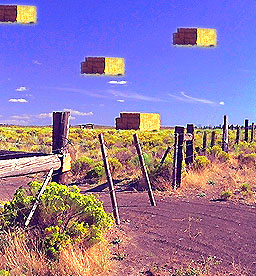
The scenes on this page are all taken at or near Evans Well, near Pine Mountain, some 40 miles east of Bend....... Evans Well's history is that of another High Desert homesteading failure, dreams blown into dust in the Drought that began around 1917, the same drought that erased a whole list of homesteading towns on the Oregon High Desert. The names include Fremont, Lake, Fleetwood, Sink, Connley, Arrow, Buffalo, View Point, Cliff, and Loma Vista*-- and don't forget other tiny spots, most of them in Harney County, and many of them only ranches with post offices-- Blitzen, White Horse Ranch, Fields, Andrews, Frenchglen, (near P* Ranch), Diamond, Mule (Mahon Ranch), Princeton, Narrows, Voltage, Venator, Oakley, and Crane, Lawen, Buchanan (J.W. Buchanan Ranch), Van (Tom Cleveland place),l Egli (near Wagontire), Riley, Suntex, Evergreen and Camp Curry Spring (Cecil Ranch)** --- it's not even a bad pun to say of these little places, "They Bit the Dust."..... This photographer first imaged Evans Well on an achingly lonely frozen winter day in 1976; under the new ownership of the Nash family since 1995, the homestead has been beautifully revived, with new well water, and now its golden hay sails to the Heavens in this fantasy. Near are Brothers and Brothers Airport and Millican and Pine Mtn.
Road to Infinity
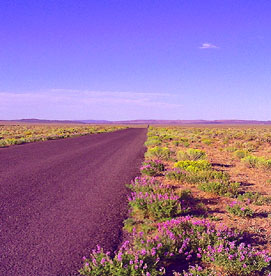
A hot, dry wind sways the purple
lupine beside a nameless stretch of empty road. Somewhere south
of us is Oregon's famous Fort Rock Cave. I rested near this spot
a few years ago, and then I saw a herd of pronghorn, but today
all is Silence, just the open untravelled Road moving its quiet
way into the distances. I stood here in peace on the shoulder
of the road totally undisturbed for most of the afternoon. For
those it does not frighten, the immense silence found in most
of the Oregon High Desert is a true national treasure, one which
Oregon's "Poet
of the Desert," C.E.S.
Wood, wrote about eloquently 85 years ago. Mr. Wood was a Portland
attorney and political activist with a strong artistic bent and
love of the desert; born 1852, saw Abraham Lincoln, went to West
 Point, friends with
Mark Twain, Indian fighter in the last defeat of the Nez Perce,
and the man who recorded and made famous Chief Joseph's elegy:
"From where the sun now stands, Joseph will fight no more,
forever." Died 1944, at the birth of the Atomic Age. The
book illustrated is by two Oregon authors and published by OSU Press, in 1997
(click link if interested). Charles Erskine Scott Wood is C.E.S's
full name.
Point, friends with
Mark Twain, Indian fighter in the last defeat of the Nez Perce,
and the man who recorded and made famous Chief Joseph's elegy:
"From where the sun now stands, Joseph will fight no more,
forever." Died 1944, at the birth of the Atomic Age. The
book illustrated is by two Oregon authors and published by OSU Press, in 1997
(click link if interested). Charles Erskine Scott Wood is C.E.S's
full name.
Final note: C.E.S. Wood was also one of the two original founders/owners of historic Cloud Cap Inn in 1889, on Mt. Hood's NE side at 6000 feet.

*The names of the ten ruined ghost towns are from Dr. Ray Hatton's 1977 book, "High Desert of Central Oregon," which I highly recommend. The names "Fremont," and "Lake" are also found in the historic climate records of Oregon. Fremont was the closest to being a "real town" among the ten places, and also has a special claim to fame in Oregon climatology.... An earlier and similar book of Eastern Oregon history was published in 1964. EAST OF THE CASCADES, by Phil Brogan, the Editor of the Bend Bulletin for many years. The Publisher was Binford and Mort of Portland.
** From "Harney County, Oregon, and Its Range Land" by George Francis Brimlow, Binford and Mort, Portland, 1955, under sponsorship of The Harney County HIstorical Society, Burns, Oregon.