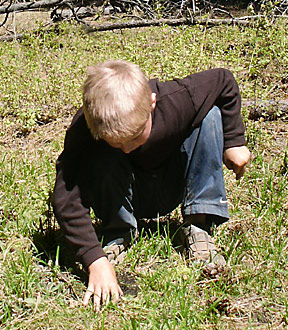
 He has stuck his fingers into the soil beneath,
and finds dark, rich, damp mud! And this at the very end of a
dry summer, in what was an official drought year!
He has stuck his fingers into the soil beneath,
and finds dark, rich, damp mud! And this at the very end of a
dry summer, in what was an official drought year!Watching the dust devils play over the
stunted sagebrush (Artemisia tridentata) and abbreviated
grasses of OSP's main telescope field, it's hard to imagine that
just 1/2 mile away and 150 feet lower things are a lot less arid
and a lot less windy.... Here Davin has found a rather extensive
area of dry, dusty hillside that is magically transformed by the
presence of oozing water just beneath the surface. He has stuck his fingers into the soil beneath,
and finds dark, rich, damp mud! And this at the very end of a
dry summer, in what was an official drought year!
The short hike down to Indian Trail Springs
swiftly brings one to green grass and big trees. 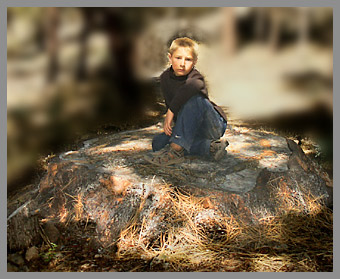 Here my son sits upon the massive stump of what
was an old-growth ponderosa pine. Our estimate from tree-ring
counting was about 250 years old, and you can see that its diameter
was over four feet! It's location was alongside the margin of
a seasonal stream, and close to where the year-round flow of Indian
Trail Springs enters this streambed and disappears. This stump
is about 100 vertical feet below where the spring waters exit
the bathtub-like watering trough shown below.
Here my son sits upon the massive stump of what
was an old-growth ponderosa pine. Our estimate from tree-ring
counting was about 250 years old, and you can see that its diameter
was over four feet! It's location was alongside the margin of
a seasonal stream, and close to where the year-round flow of Indian
Trail Springs enters this streambed and disappears. This stump
is about 100 vertical feet below where the spring waters exit
the bathtub-like watering trough shown below. 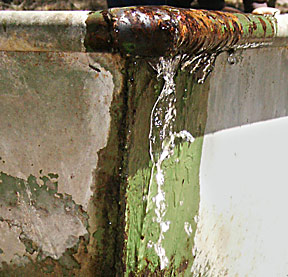
Water, green things, mud, big trees, these are certainly some reasons Indian Trail Springs was a favored camping place for many generations of Native Americans, some of them probably on their way coming or going from the salmon gatherings at Celilo Falls on the Columbia River.
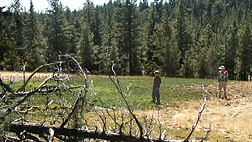
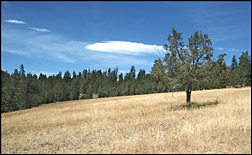
About 100 yards down from the bathtub, the spring waters widen out into a large expanse of muddy green grasses. Just to the right of the green, the typical dry prarie resumes, although down here in the canyons, there are fewer rocks, very little sagebrush, and overall it looks like great forage for deer and elk-- and, after all, this whole area around the springs is an actual designated elk refuge! And all the more isolated since the early 1990s, when the Forest Service took down the road sign pointing to it, and then allowed trees to fall across it and never removed them! Speaking of deer and elk, they are a fovored food for COUGARS, and in 2011 a group hiking back from the springs saw and felt they were being observed by a curious cougar.
 OregonPhotos.com